
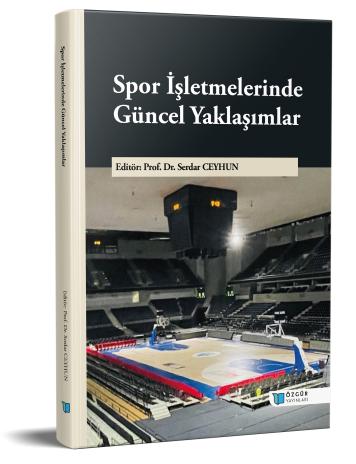
Factors Affecting Customer Participation in Sports Facilities
Chapter from the book:
Ceyhun,
S.
(ed.)
2025.
Current Approaches in Sports Businesses.
Synopsis
This study examines the factors influencing participation in sports facilities comprehensively and investigates the importance of sports facilities based on the perceptions, expectations, and experiences of sports consumers (spectators). The sports sector is considered a multidimensional field that meets individuals’ sporting and social needs through voluntary organisations, public institutions, and private enterprises. Today, sports consumers’ participation in facilities is not limited solely to match outcomes or athletic success; rather, it is influenced by various factors, including the physical environment, accessibility, service quality, safety, social interaction, and aesthetics. In the study, the physical characteristics of sports facilities (lighting, heating–cooling systems, seating comfort, hygiene), ease of transportation and adequacy of parking, social environment and opportunities for socialization, identity formation and team identification, service quality, pricing, safety, perceptions of violence, signage, aesthetic elements, scoreboard usage, and the impact of star players are examined in detail. Each of these factors directly or indirectly affects sports consumers’ satisfaction levels, intentions to revisit, and perceptions of the facilities. The research findings indicate that high-quality service delivery, a safe and comfortable facility environment, easy accessibility, and positive social experiences all contribute to increased participation in sports facilities. Moreover, the success of sports facilities is not limited to athletic performance alone; it is directly related to a customer-oriented service approach, high perceived service quality, a safe and aesthetically pleasing physical environment, ease of transportation, and positive social experiences. In today’s increasingly competitive environment and with the widespread emergence of a more conscious consumer profile, the sustainability and attractiveness of sports facilities depend on providing visitors with holistic and memorable experiences. In addition, due to the continuously changing expectations of customers, it is emphasised that sports facilities should be managed in line with the principles of sustainability, planning, and innovation. As a result, customer-oriented approaches should be adopted in sports facilities, prioritising experience quality and targeting long-term satisfaction.
How to cite this book
License

This work is licensed under a Creative Commons Attribution-NonCommercial 4.0 International License.
Published
DOI
Categories
Copyright (c) 2025 Serdar Ceyhun; Serdar Ceyhun- İbrahim Gümüşboğa- Faik Orhun Tapşın- Mustafa Kenan Şeker- Cemal Özman- Suna Aslıhan Ayhan Çukur- Hakan Sunay