
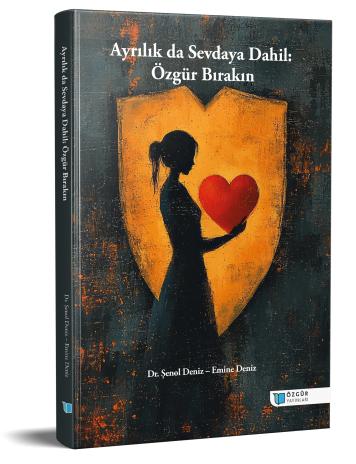
Even Separation Belongs to Love: Set Them Free
Synopsis
This book emerges from a shared intellectual and emotional terrain shaped by two authors who deliberately chose to write not about the human condition, but from within it. Positioned at the intersection of literature, psychology, and philosophical inquiry, the work resists easy classification. It is neither purely academic nor merely literary; rather, it occupies a liminal space where emotional truth and analytical rigor coexist. Attilâ İlhan is not incorporated into this book as a decorative literary reference, but as a companion voice at times guiding, at times confronting, and often unsettling. His lines function as thresholds through which the reader is invited to enter deeper layers of emotional and psychological reflection.
From an editorial perspective, the central premise of the book is clear and unapologetic: the inner life of the human being cannot be understood through idealized narratives of love, resilience, or identity. It must instead be approached through fracture, absence, and emotional insufficiency. Throughout the book, themes such as love, attachment, loss, obligation, loneliness, and emotional dependency are examined without romantic softening. They are presented as lived experiences with psychological weight. Attilâ İlhan’s recurring insistence on inner breakage “they broke me too, they broke me inside” echoes the book’s core concern: emotional wounds are not always inflicted loudly or violently; they are often the result of quiet neglect, internalized abandonment, and prolonged self-erasure.
Academically, the book adopts an explicitly interdisciplinary stance. It draws on psychological theory, literary analysis, existential philosophy, and cultural critique, while resisting the rigid boundaries that often separate these fields. Clinical concepts are not treated as closed systems of explanation but as interpretive tools, complemented by the intuitive and metaphorical power of literature. Human experience, the book argues, cannot be fully articulated through definitions alone. It requires imagery, rhythm, silence, and contradiction. In this sense, Attilâ İlhan’s lines operate as an interface where emotion crystallizes into thought and thought destabilizes emotion. His stark declaration “I am nothing to someone”—opens a space for examining attachment theory, narcissistic injury, emotional invisibility, and the fragile construction of self-worth.
The deliberate use of “we” throughout the book is neither stylistic coincidence nor rhetorical ornament. It reflects the collaborative nature of the writing process itself. This text was not produced through seamless agreement, but through sustained dialogue, tension, and mutual interrogation. At times, one voice recedes while the other advances; elsewhere, both intersect within the same sentence from different emotional angles. The resulting texture is intentionally layered. The reader is invited to experience this plurality not as inconsistency, but as a faithful representation of the human psyche fragmented, polyphonic, and often unresolved.
Emotionally, the book refuses to centre idealized love. Instead, it dwells on failed attachments, unreciprocated devotion, and relationships that never fully materialize—those that leave no shared photographs, no tangible proof, only asymmetrical memories. Yet the narrative does not surrender to sentimental melancholy. Emotional pain is treated as a site of meaning-making rather than passive suffering. Psychological resilience, in this framework, is not equated with strength or recovery, but with the capacity to remain present with pain without denying it. Attilâ İlhan’s line “death is forbidden” is read not as despair, but as existential insistence: a mandate to endure, to remain alive even when meaning collapses.
Literarily, the book adopts a hybrid language poetic without being obscure, academic without being sterile. This is not a stylistic experiment for its own sake, but a methodological necessity. Emotion stripped of language becomes mute; theory detached from feeling becomes hollow. The text therefore oscillates between essayistic reflection and conceptual analysis, always anchored in lived experience. Attilâ İlhan’s sharp, sometimes unforgiving tone does not disrupt this balance; it sustains it. His refusal to console mirrors the book’s ethical stance: understanding begins where illusion ends.
Psychologically, the work pays particular attention to internal collapse, chronic emotional deprivation, and the normalization of loneliness in modern relational life. These experiences are not framed as individual pathologies, but as shared conditions shaped by cultural expectations and relational economies. The phrase “they broke me inside” becomes a diagnostic metaphor pointing not to external perpetrators alone, but to the cumulative effect of self-neglect, emotional minimization, and learned silence. The book does not ask the reader to assign blame; it asks them to recognize patterns.
As an editorial introduction, this text does not aim to glorify the book, but to position it honestly. This is not a text designed for rapid consumption. It demands attentiveness, emotional openness, and intellectual patience. In return, it offers no definitive answers only carefully articulated questions. The authors believe that the book will resonate particularly with scholars, writers, and thinkers working in the liminal spaces between psychology and literature. At the same time, it extends an invitation to any reader willing to confront their own emotional history without defensive simplification.
It must be stated clearly: this is not a book of hope, but it is not a book of despair either. Its ethical commitment lies elsewhere in advocating for a form of honesty that does not promise salvation but insists on awareness. Attilâ İlhan’s voice is present throughout but never totalizing. His lines serve as points of departure rather than conclusions. The book ultimately claims its own voice, one that is shaped by dialogue, fracture, and exposure.
The authors did not protect themselves in the writing of this book. They allowed the text to unsettle them, to reopen unresolved questions, to challenge comfortable narratives. As a result, the work is not flawless but it is authentic. It suggests that love does not always redeem, that relationships do not always heal, but that they inevitably confront us with ourselves. And sometimes, that confrontation is the most instructive experience of all.
How to cite this book
License

This work is licensed under a Creative Commons Attribution-NonCommercial 4.0 International License.
Published
ISBN
DOI
Statistics
Categories
Copyright (c) 2026 Şenol Deniz- Emine Deniz