
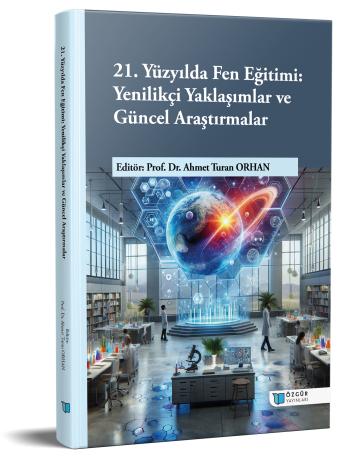
Science Education in the 21st Century: Innovative Approaches and Current Research
Synopsis
The book titled “Science Education in the 21st Century: Innovative Approaches and Current Research” consists of six chapters.
In the first chapter, titled “An Examination of the Montessori Approach in Early Childhood Science Education Using a SWOT Analysis: Teacher Perspectives and a Literature Review,” the Montessori approach in early childhood science education is examined through a SWOT analysis based on teacher perspectives and the literature. The findings indicate that the approach is strong in terms of active learning and academic achievement; however, factors such as high material costs, limited technology integration, and teacher competence pose challenges to its implementation. Additionally, while parental support presents a significant opportunity, family attitudes and educational deficiencies have been identified as potential threats.
In the second chapter, titled “A Comparison of the Turkey Century Maarif Education Model in the Context of STEM Education,” the conceptual and pedagogical alignment between the Turkey Century Maarif Model and STEM education is examined. The study concludes that both approaches aim to promote interdisciplinary learning, student-centered instruction, and the development of 21st-century skills. It also emphasizes that the model supports STEM-based learning processes through values, skills, and a holistic understanding of development.
The third chapter, titled “Science Teachers’ Perceptions of Innovation in Science Education: A Phenomenological Study,” was conducted using a phenomenological design to determine science teachers’ perceptions of innovation in science education. The findings indicate that teachers view innovation as novelty and progress, and believe it can enhance student motivation and learning retention. However, it was determined that factors such as curriculum intensity, an exam-focused system, insufficient resources, and lack of knowledge limit innovative practices.
In the fourth chapter, titled “Preschool Teachers’ Views on STEM Practices,” a qualitative study was conducted to examine preschool teachers’ views on STEM practices. The findings indicate that teachers view STEM practices as a beneficial approach that fosters creativity, collaboration, and scientific process skills. However, shortages of materials and time, along with a lack of institutional support, create significant limitations in the implementation process.
Chapter 5, titled “In Light of Current Research: The Integration of Artificial Intelligence and STEM in Science Education,” examines current research on the integration of artificial intelligence with the STEM approach in science education. The findings indicate that AI-supported STEM applications enhance students’ academic achievement, problem-solving skills, motivation, and 21st-century skills. However, the text emphasizes that technical infrastructure shortages, access issues, and ethical concerns represent significant limitations that must be addressed in this integration process.
In the sixth chapter, titled “The National Technology Initiative in Textbooks Prepared Within the Framework of the Turkey Century Education Model,” the study examines how the National Technology Initiative is highlighted in 5th and 6th-grade science textbooks prepared under the Turkey Century Education Model. The findings indicate that examples of national technology in the textbooks are used as a context-based learning tool to support students’ understanding of scientific concepts. However, it was concluded that the content is largely limited to space and aviation technologies and that different technology fields need to be represented more extensively.
I would like to extend my sincere thanks to the chapter authors for their valuable contributions to the creation of this book.
Editor
Prof. Dr. Ahmet Turan ORHAN
Chapters
How to cite this book
License

This work is licensed under a Creative Commons Attribution-NonCommercial 4.0 International License.
Published
ISBN
DOI
Statistics
Categories
Copyright (c) 2026 Ahmet Turan Orhan; Sümeyya Kuş Gürbey- Uğur Büyük- Hatice Sena Yıldırım- Hamdi Karakaş- Habibe Karaal- Cenk Yoldaş- Ayşenur Yazar- Özge Kol- Mehmet Akif Arduç