
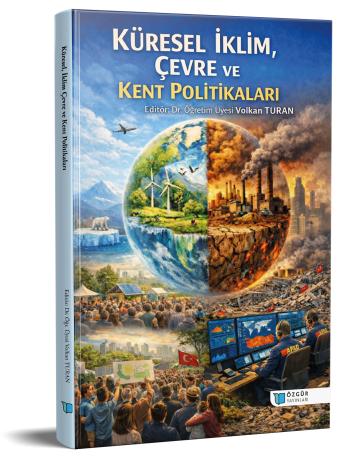
Global Climate, Environment and Urban Policies
Synopsis
Climate change, one of the most decisive global issues of the 21st century, goes beyond being merely an environmental matter; it represents a multi-layered transformation process that directly shapes the future of cities through its economic, social, and administrative dimensions. Climate change is considered one of the greatest challenges facing the global community today, as it is boundless and affects all countries, regardless of their level of development. Rising temperatures, extreme weather events, pressures on water resources, changes in energy demand, and increases in disaster risks; produce more visible and impactful consequences, particularly in cities with dense populations and infrastructure concentrations. Therefore, cities are considered both the areas where the effects of the climate crisis are felt most acutely and the spatial and administrative scales with the highest capacity to produce solutions. Adapting to the consequences of climate change protects people, homes, businesses, livelihoods, infrastructure, and natural ecosystems. If measures are not taken, climate change will reverse much of the development progress made in recent years. Additionally, climate change could intensify conflicts over resources and force people to relocate.
The book prepared in this context is structured around themes that complement each other, such as combating climate change, climate adaptation, sustainable urban policies, energy transition, disaster management, and local governance. The study, which was created through the contributions of academics from different disciplines, aims to provide an academic discussion platform by bringing together international practice examples and theoretical approaches to prepare cities for a sustainable, resilient, and inclusive future.
One of the prominent topics in the literature in recent years has been urban cooling policies. Increasing temperatures on a global scale and urbanization processes strengthen the "urban heat island" effect, negatively impacting thermal comfort and public health in cities. Recent research show that strategies such as green and blue infrastructure practices, increasing urban green spaces, water surfaces, shading systems, and reflective building materials play an important role in reducing urban temperatures. Increasing green infrastructure and tree cover, especially in cities, contributes to reducing temperatures and making cities more resilient to climate change.
Another important approach in climate adaptation policies is the "Sponge Cities Initiative". This model, implemented in China, aims to reduce flood risks through ecological systems that absorb, store, and reuse rainwater in cities. As part of the pilot program initiated in 2015, nature-based solutions such as permeable surfaces, green roofs, rain gardens, wetlands, and natural drainage systems have been implemented in approximately 30 cities. The primary purpose of this model is to retain and reuse a significant portion of rainfall that falls in cities. Thus, both the resilience of cities against flood risks is enhanced and sustainable water management is ensured.
The role of cities in combating climate change is not limited to physical infrastructure adjustments. The climate-neutral and smart cities approach aims to reduce cities' carbon footprint through digital technologies, data-driven governance, and energy efficiency policies. Smart city applications enable more efficient management of urban services and optimization of energy use through sensor technologies, the Internet of Things (IoT), data analytics, and digital energy management systems. Such technological solutions play an important role in developing low-carbon urban economies and establishing sustainable urban management models.
An important component of this transformation process is renewable energy and sustainability policies. In current literature, it is emphasized that energy transition is not merely a technological process; it is also closely related to institutional structures, economic incentive mechanisms, and governance models. The institutional economics perspective reveals that the effectiveness of sustainable energy policies is directly linked to the functioning of institutions, regulatory frameworks, and public policies. In this context, supporting renewable energy investments, carbon reduction policies, and sustainable economic transformation strategies are at the heart of cities' climate policies.
The effects of climate change on cities are evaluated not only in environmental terms but also in the context of disaster risks. One of the sustainable development goals is to strengthen resilience and adaptive capacity to climate-related hazards and natural disasters in all countries. Integrated disaster management and resilient city policies have become one of the fundamental components of urban planning today. Since cities are complex structures where social and physical infrastructure systems are interdependent, natural disasters can cause cascading effects among these systems. Therefore, adopting an integrated approach that encompasses disaster risk reduction, preparedness, response, and recovery processes is of critical importance in enhancing cities' resilience to crises.
The transformation of cities into sustainable and resilient is not possible solely through technical and administrative policies. Local democracy and participatory governance also play a crucial role in this process. Communication mechanisms established by local governments with citizens, public participation processes, and public relations practices increase the legitimacy and effectiveness of urban policies. The participatory governance approach strengthens the social acceptance of sustainable policies by ensuring the inclusion of city residents in decision-making processes.
This book examines the transformation of cities in the face of climate change from a broad perspective, ranging from urban cooling policies to sponge city applications, from climate-neutral and smart cities to renewable energy policies, from integrated disaster management to local democracy and public relations approaches. Bringing together academic studies from different disciplines, this work aims to contribute to current academic discussions on preparing cities for a sustainable, resilient, and inclusive future in the age of climate change.
The book consists of seven chapters. In the first chapter; Esra KESKİN, Nisa Nur KÜLAHÇI CEBE, and Emine BAYDAN, with their study titled “Urban Cooling Policies in Turkish Cities within the Framework of Spanish and Italian Practices,” examined urban cooling approaches comparatively, within the context of planning policies and governance tools, using the examples of Spain and Italy. They have addressed urban cooling not only as a technical intervention area, but also as a planning issue integrated with climate change adaptation, public space quality improvement, and sustainable urban development goals. In this context, the study analysed national climate adaptation policies, local climate action plans, and green infrastructure strategies in both countries. By comparing urban cooling policies in Spain and Italy, they demonstrated that despite similar climatic pressures, urban cooling strategies are shaped according to different institutional structures and spatial logics. He pointed out that urban cooling should not be evaluated solely on physical interventions; but within the framework of planning culture, local government capacity, and governance structures. The chapter presents an analytical framework for developing adaptable policy principles for Turkish cities based on the experiences of these two countries.
In the second chapter; Ali KİRİKTAŞ stated that due to the increasing acceleration of climate change and rapid urbanization dynamics on a large scale, metropolises around the world face severe urban flooding, depletion of underground water resources and multidimensional ecological crises with his study entitled “Sponge City Initiative: Climate Adaptation in 30 Chineese Cities”. In this regard, it has been determined that the ”Sponge City Initiative- SCI" (Sponge City Initiative- SCI), conceptualized by the People's Republic of China in 2013 and implemented in a total of 30 pilot cities in 2015-2016, is one of the most comprehensive urban climate adaptation policies. In this chapter, the historical and philosophical origins of the initiative, its engineering applications, ecological-economic performance metrics, and the structural challenges it faces are analysed in detail. Landscape architect Kongjian Yu stated that this model, developed on inspiration from ancient Chinese agricultural sages, is based on the principles of Low Impact Development (LID), which aims to retain, absorb, filter, and reuse rainwater at its source. While analysing the applications in pilot cities with diverse geographical and climatic characteristics in the People's Republic of China, such as Wuhan, Shenzhen, Xining, and Sanya, the macroeconomic dynamics of Public-Private Partnership (PPP) financing models were also evaluated. Finally, a critical perspective is presented that the initiative is not merely an ecologically or engineering-based neutral project; rather, it is a political tool that creates spatial inequalities through urban gentrification, environmental justice, and hydro-social dynamics.
In the third chapter; Giray BUTUR and Murat NAZLI stated that the role of cities in combating climate change has become critical with their work titled “Climate Neutral and Smart Cities Mission of Izmir: Present and the Future” and that the EU's “Climate Neutral and Smart Cities Mission” offers a systemic innovation framework for urban decarbonisation. In this chapter, the strategic road map developed by Izmir, one of the 112 cities selected within the scope of the Mission, to achieve climate neutrality by 2030 is examined. The study employed a mixed-methods approach combining the analysis of Climate City Contract (CCC) documents with semi-structured interviews conducted with stakeholders and decision-makers. The study revealed how İzmir integrated existing strategies such as the Sustainable Energy and Climate Action Plan with the “GCC-SYNERGY” pilot project, which digitalizes energy consumption, and the multi-stakeholder “Global Climate Community” governance model.
In the fourth chapter, Mine KILINÇ, with her work titled “Analysis of Renewable Energy and Sustainability Policies in Türkiye from a Corporate Economics Perspective,” evaluated renewable energy and sustainability policies in Türkiye comprehensively from a corporate economics perspective. It has been stated that the increasing energy demand, dependence on fossil fuels, and climate change pressures have transformed renewable energy investments from being merely a technical and economic choice into a policy area that must be addressed with environmental and institutional dimensions. In the chapter, the renewable energy transition in Turkey is analysed through descriptive and comparative tables using indicators related to installed capacity development, the structure of incentive mechanisms, resource distribution in energy production, and the trend of carbon emissions over time. The findings showed that there was a significant increase in renewable energy installed capacity during the 2010–2023 period, and that the share of renewable sources in total installed capacity rose remarkably. However, it has been determined that this quantitative expansion has not been accompanied by a significant reduction in carbon emissions; rather, fossil fuels have largely retained their dominance in energy production. This chapter contributed to the literature by addressing renewable energy policies considering incentive design, institutional alignment, and environmental outcomes rather than capacity expansion.
In the fifth chapter; Sultan YILDIRIM TUTAR and Ayşe GÜNEŞ BAYIR, in their study titled “The Development of Disaster Management in Türkiye,” examined the evolution of disaster management perception in Türkiye from a historical perspective. The laws enacted, institutions established, and changes in governance strategies throughout the period from the Ottoman era to the present day are discussed in chronological order. They specifically noted that the 1999 Marmara Earthquake was a turning point for Türkiye and analysed the transition process from the old "response-oriented" system focused solely on crisis moments to the modern "risk-based" management approach that aims to identify and prevent potential risks in advance. In addition, the vital importance of early detection of disaster risks and damage reduction activities was emphasized. How the existing system functions in terms of inter-institutional cooperation, the effectiveness of central coordination, and the establishment of sustainable disaster policies was analysed. The chapter provides an objective overview of the current state of the disaster management system in Türkiye and presents solution proposals to make the practices more efficient.
In the sixth chapter; Cemal ÖZDEMİR discussed the transition from a traditional reactive understanding of disaster to a proactive and network-based governance model by considering the multidimensional effects of the global climate crisis on cities from the perspective of integrated disaster management and urban resilience with his study entitled “Cities in the Grip of the Global Climate Crisis: Integrated Disaster Management and Resilient Urban Policies”. It has been stated that in addition to being responsible for a large portion of global emissions, cities have become places that experience the most severe consequences of climate-related disasters. The concept of resilient cities has been reinterpreted not only in terms of physical resilience, but also through the continuity of logistics flows, green infrastructure systems, nature-based solutions, and inclusive social policies. Özdemir highlighted the importance of implementing global policy documents such as the Sendai Framework for Disaster Risk Reduction, SDG 11, and the Paris Climate Agreement at the local level, and discussed innovative approaches like risk-based spatial planning, the sponge city model, and green corridors. Moreover, Özdemir presented an interdisciplinary framework and demonstrated the necessity of integrating planning, logistics, and environmental policies for cities to adapt to the climate crisis.
In the seventh chapter; Nurettin BİLMEZ, in his work titled “An Evaluation on the Role of Public Relations in Strengthening Local Democracy,” examined the role and importance of public relations in strengthening local democracy within a conceptual and analytical framework. In terms of scope, he analysed key concepts such as local democracy, decentralization, public relations, participatory democracy, and governance, as well as theoretical frameworks such as traditional public administration, new public management, and public relations models. A comparative evaluation was conducted by reviewing local and foreign literature; an original conceptual model was proposed. This chapter has contributed to the literature by establishing interdisciplinary bridges, analysing local contexts, and proposing practical suggestions.
Chapters
How to cite this book
License

This work is licensed under a Creative Commons Attribution-NonCommercial 4.0 International License.
Published
ISBN
DOI
Statistics
Categories
Copyright (c) 2026 Volkan Turan; Esra Keskin- Nisa Nur Külahçı Cebe- Emine Baydan- Ali Kiriktaş- Giray Butur- Murat Nazlı- Mine Kılınç- Cemal Özdemir- Nurettin Bilmez- Sultan Yıldırım Tutar- Ayşe Güneş Bayır