
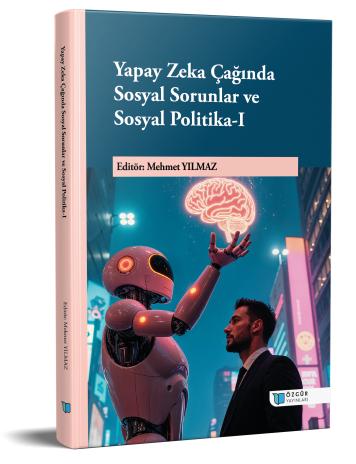
Social Problems and Social Policy in the Era of AI-I
Synopsis
The stage reached by the knowledge society following industrialization is today referred to as Society 5.0, succeeding Industry 4.0. In this phase, the concepts of digitalization and artificial intelligence (AI) come to the fore. Digitalization can be briefly defined as the conversion of information into digital format; however, it also represents the process of restructuring social life, business, human-machine interaction, and socialization around digital technologies. Artificial intelligence, as is well known, is expressed as the ability of machines or software to mimic cognitive functions unique to human intelligence, such as learning, reasoning, problem-solving, and decision-making. Within this framework, the new Society 5.0 stage emerging from the convergence of digitalization and AI is defined as a "social structure centered on human well-being through the full integration of cyber and physical spaces (Internet of Things, AI, Big Data)." Although this developmental stage is described as a structure prioritizing human welfare, it unfortunately harbors inherent risks, handicaps, and problem areas.
The most significant handicap is the risk of even the most capillary data of all societies falling into the hands of the creators of this technology under the glorification of "big data," leading to issues of privacy violations and the processing, sale, or theft of personal data. In this context, another critical problem is the act of self-disclosure of our own privacy for the sake of "personal well-being." This issue can be conceptualized as "surveillance capitalism."
A second major issue is the problem of digital/virtual addiction. Various studies reveal that social media algorithms are designed to track personal usage habits and direct users to stay on platforms for longer periods; this design is reinforced with emotional responses such as pleasure, joy, curiosity, and anger, thereby functioning like "digital slot machines" to create addiction. According to 2026 TurkStat (TÜİK) and ICTA (BTK) data, daily internet usage has exceeded 7 hours, with more than 4 hours spent on smartphones. It is stated that this addiction leads to the problem of "brain rot," also referred to as "popcorn brain." Here, concepts such as "artificial loneliness," "digital isolation," and "cyberbullying" gain prominence. Social isolation and atomization, by reducing or nearly eliminating physical social interactions, transform individuals into "zombies" roaming the streets and drag everyone—regardless of being a child, youth, or elderly—into a spiral of digital violence. One of the underlying causes of the proliferation of peer bullying, violence against women, and the economic exploitation and fraud targeting the elderly is the aforementioned "digital isolation" and "digital narcissism."
Another significant problem area is the loss of information reliability, disinformation, and the increasing risk of social chaos. Masses can be easily manipulated by a 2-3 minute video or a social media message consisting of only a few sentences. Furthermore, the risk of technological unemployment arising alongside the AI and robotics industry constitutes another major challenge.
This book examines several of these next-generation social issues arising in the age of artificial intelligence across five distinct chapters. In the first chapter, Dr. Mehmet Yılmaz discusses the emerging risks and social problems associated with the spread of digitalization and AI applications, providing a general evaluation.
In the second chapter, Dr. Arif Akbaş focuses on the concepts of "fear of the future" and the "society of fear" as global risks stemming from the uncertainties created by the climate crisis. In the third chapter, Nesrin Yazar evaluates intergenerational interaction and generational gaps within the framework of technological change through case studies. The unique socialization patterns, socio-political events, and reactions to various social phenomena of each generation are illustrated with specific cases. In this regard, the second and third chapters provide mutually supportive sociological analyses concerning the infrastructure of digitalization and new social problems.
In the fourth chapter, Dr. Cumhur Havan, in his English article titled “Women’s Integration in Migration Contexts: Violence, Digital Vulnerabilities and Hybrid Social Policy Responses in Türkiye,” focuses on violence against migrant women—particularly digital violence and discrimination—and offers social policy recommendations for these issues.
The fifth and final chapter of the book is dedicated to the impacts of artificial intelligence on employment and labor markets. Dr. Sergen Gürsoy addresses technological unemployment, often referred to as "creative destruction," and the emerging new opportunities within the framework of the transformation of social policy.
Chapters
How to cite this book
License

This work is licensed under a Creative Commons Attribution-NonCommercial 4.0 International License.
Published
ISBN
DOI
Statistics
Categories
Copyright (c) 2026 Mehmet Yılmaz; Arif Akbaş- Cumhur Havan- Sergen Gürsoy- Nesrin Yazar- Mehmet Yılmaz