
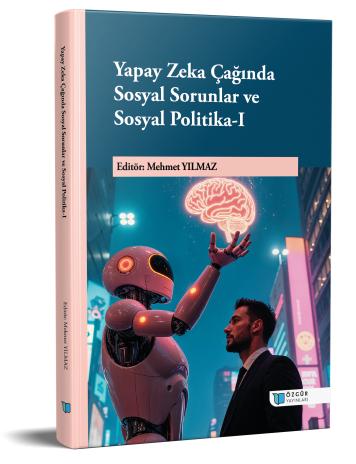
The Redistribution of Social Risks in the Age of Artificial Intelligence: Employment Risks and the Transformation of Social Policy
Chapter from the book:
Yılmaz,
M.
(ed.)
2026.
Social Problems and Social Policy in the Era of AI-I .
Synopsis
Among the effects of intense globalization, the field of labor economics is the most affected. This study aims to discuss the nature of employment risks arising from the creative destruction mechanism, alongside the increase in social risks in labor relations in the age of artificial intelligence, and the transformation of social policy understanding. Technological developments increase the risk of job loss by creating a substitution effect on certain occupations and transforming the components of jobs. Thus, potential risks are defined not as unemployment occurring at a specific moment but as a form of fragility that permeates the entirety of working life. With the ongoing transformation, the speed of job transitions is increasing due to reasons such as skills mismatch, fluctuating working conditions, the expansion of atypical work, and algorithmic management. Ultimately, employment risk is turning into a socio-political risk area, including the threat of dismissal, questioning of income and working conditions, precarious work, and restricted access to social rights. The study agrees that the new risk phenomenon has asymmetric effects on disadvantaged groups. Those working in routine jobs requiring low and medium-level skills, those who have recently entered the labor market, women experiencing career instability due to caregiving responsibilities, migrants, and informal workers are significantly affected by AI-driven transformation. In this context, the transformation of the social policy framework is addressed within a three-tiered structure. First, passive protections are being comprehensively updated; short-time work and income compensation tools, insurance designs covering atypical workers, and portable rights are coming to the fore. Then, the redesign of active labor market policies (on-the-job training, skills acquisition, counseling, etc.) becomes important. Finally, regulations based on acquired rights and algorithmic governance prioritize a socio-political approach that commits to ensuring job protection alongside inter-job transition security.
How to cite this book
License

This work is licensed under a Creative Commons Attribution-NonCommercial 4.0 International License.
Published
DOI
Categories
Copyright (c) 2026 Mehmet Yılmaz; Arif Akbaş- Cumhur Havan- Sergen Gürsoy- Nesrin Yazar- Mehmet Yılmaz