
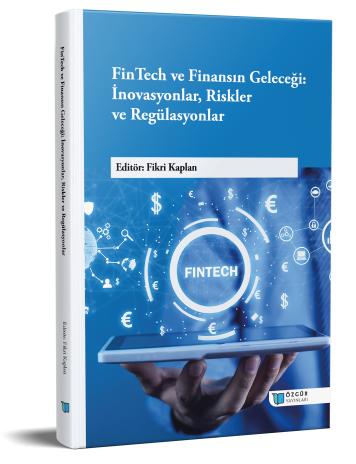
FinTech and the Future of Finance: Innovations, Risks, and Regulations
Synopsis
Financial systems have continuously evolved throughout history in parallel with technological advancements; however, the digital transformation experienced over the last two decades has marked a qualitative turning point in this evolution. The rise of financial technologies (FinTech) has fundamentally reshaped the functioning, actors, and value creation mechanisms of the financial sector. FinTech is no longer merely a field of technological innovation; rather, it has emerged as a strategic paradigm that drives the transformation of financial architecture, institutional structures, and regulatory frameworks .
This book aims to provide a comprehensive analysis of the future of finance by examining the FinTech ecosystem from a multidimensional perspective. The chapters included in this volume present an interdisciplinary framework covering a wide spectrum, ranging from conceptual foundations and ecosystem structures to entrepreneurship dynamics, leadership approaches, digital governance, organizational culture, and regulatory processes.
The book begins by addressing the conceptual evolution of FinTech and its development within an ecosystem framework. The FinTech ecosystem is conceptualized as a multi-actor network involving entrepreneurs, traditional financial institutions, regulatory authorities, technology providers, and users. This structure facilitates the delivery of financial services in a faster, more accessible, and customer-oriented manner while simultaneously enhancing financial inclusion . At the same time, this transformation introduces new categories of risks that require careful consideration.
Another key focus of the book is the transformative impact of FinTech on the entrepreneurial ecosystem. Digital platforms, alternative financing mechanisms, and data-driven business models are reshaping entrepreneurial activities, while the disruptive innovation potential of FinTech is redefining traditional financial intermediation processes . In this respect, FinTech is positioned not only as a financial innovation domain but also as a structural force that redefines global entrepreneurship dynamics.
A further critical dimension addressed in this volume is digital governance. The relationship between FinTech and digital governance highlights the delicate balance between innovation and regulation. Issues such as data governance, algorithmic transparency, cybersecurity, and regulatory compliance are identified as key determinants of the sustainability of the FinTech ecosystem . The book emphasizes that technological advancement brings not only opportunities but also significant governance and risk management challenges.
In addition, the book explores leadership and organizational culture within FinTech organizations. Effective management of digital transformation, the development of an innovation-driven culture, and the establishment of agile organizational structures are identified as critical factors for achieving sustainable competitive advantage . Similarly, customer-centricity, flexibility, and data-driven decision-making processes are highlighted as core elements of FinTech organizational culture .
The interaction between FinTech, banking, and regulation is also examined, particularly within the context of Türkiye, providing insights into the implications of digital finance for financial stability, competition, and consumer protection . In this regard, the book offers a holistic perspective that integrates global trends with local dynamics.
In conclusion, this book approaches FinTech not merely as a technological transformation but as a complex, multi-layered system positioned at the intersection of innovation, risk, and regulation. As a comprehensive reference for academics, policymakers, industry professionals, and researchers, this volume aims to contribute significantly to understanding and shaping the future of finance.
Chapters
How to cite this book
License

This work is licensed under a Creative Commons Attribution-NonCommercial 4.0 International License.
Published
ISBN
DOI
Statistics
Categories
Copyright (c) 2026 Fikri Kaplan; Mehmet Kaplan- Özgür Günal- Nesli Yücel- Alper Bahadır Dalmış- R. Dilek Koçak- Hümeyra Koru- Gaye Onan- Çağdaş Türkoğlu