
AI-Supported Turkish Language Teaching: Pedagogical Approaches, Applications, and Future Vision
Chapter from the book:
Kılıç Avan,
Ş.
&
Kalenderoğlu,
İ.
(eds.)
2026.
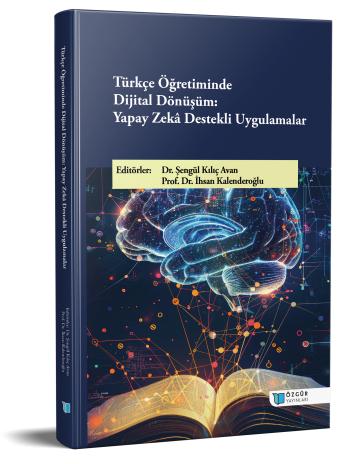
Digital Transformation in Turkish Language Teaching: AI-Powered Applications.
Synopsis
This book chapter addresses the integration of rapidly developing Generative Artificial Intelligence (GAI) technologies and Large Language Models (LLM) into the processes of teaching Turkish as a native and foreign language from a theoretical and application-oriented perspective. The study is based on the constructivist approach, where artificial intelligence is positioned as a "scaffolding" and "cognitive partner" for the student. The chapter first examines the place of the agglutinative structure of Turkish in Natural Language Processing (NLP) processes and the possibilities offered by transformer architecture to language teaching with technical depth. Subsequently, the dynamic material production and instant feedback mechanisms offered by artificial intelligence in developing reading, writing, listening, and speaking skills are exemplified with concrete application examples and prompt strategies. Furthermore, the study discusses the changing roles of teachers in the context of "Prompt Engineering," drawing attention to ethical limitations such as AI hallucinations, lack of cultural context, and data privacy. The conclusion section emphasizes the critical role that RAG (Return on Agility) architecture and interdisciplinary STEM integration will play in the future of Turkish language teaching, and offers strategic recommendations for researchers and practitioners.
How to cite this book
License

This work is licensed under a Creative Commons Attribution-NonCommercial 4.0 International License.
Published
DOI
Categories
Copyright (c) 2026 Şengül Kılıç Avan- İhsan Kalenderoğlu; Şengül Kılıç Avan- İhsan Kalenderoğlu- Hüseyin Sayın- Bilal Ferhat Karadağ- Soner Garip- Rasim Tarakcı- Bekir Sıddık Kılıç- Merve Ercan- Oğuzhan Uzun- Kadir Coşkun- Arif Akçay- Çağrı Avan- Halil İbrahim Akyüz