
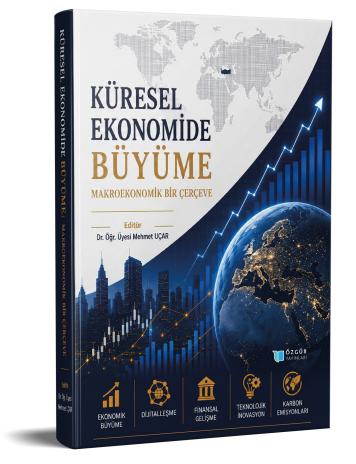
The Relationship Between Economic Freedom and Growth: Causality Analysis in Türkiye and the Turkic Republics
Chapter from the book:
Uçar,
M.
(ed.)
2026.
Growth in the Global Economy: A Macroeconomic Framework.
Synopsis
This research examines the relationship between economic freedom and economic growth using panel data analysis in a sample of Turkic Republics and Turkey. The research covers the period 2000-2021 and utilizes data from Azerbaijan, Kazakhstan, Turkmenistan, Uzbekistan, Kyrgyzstan, and Turkey. Gross domestic product per capita represents economic growth, and the economic freedom index represents economic freedom. Initially, cross-sectional dependence, homogeneity, and unit root tests were applied to determine the structural characteristics of the series. Based on the preliminary test findings, the causal relationship between the variables was investigated using the Dumitrescu and Hurlin (2012) panel causality test. The findings indicate cross-sectional dependence among the panel units and a heterogeneous structure of the coefficients. After making appropriate transformations based on the unit root test results, the causality analysis suggests a unidirectional causal relationship from economic growth to economic freedom. Conversely, no statistically significant causal relationship was found from economic freedom to economic growth. The results show that in the group of countries examined, improvement in economic performance can create transformation in the areas of institutional structure and economic freedom, but economic freedom does not emerge as a direct determinant of growth during the same period.
How to cite this book
License

This work is licensed under a Creative Commons Attribution-NonCommercial 4.0 International License.
Published
DOI
Categories
Copyright (c) 2026 Mehmet Uçar; Mehmet Uçar- Mücahit Ülger- Mert Anıl Atamer- Ayşe Eryer- Gülferah Ertürkmen- Melek Kıdemli- Lokman Salih Erdem- Kamuran Yıldız- Hüseyin Saltan