
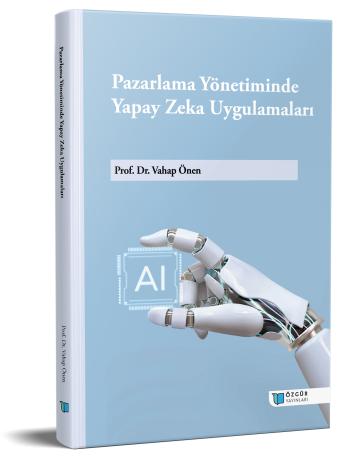
The Humanoid Face of AI: An Opportunity or a “Uncanny Valley” for Brands?
Chapter from the book:
Önen,
V.
(ed.)
2026.
Artificial Intelligence Applications in Marketing Management.
Synopsis
This study examines the anthropomorphic representations of artificial intelligence in marketing and analyzes whether these technologies constitute an opportunity or a risk—particularly through the lens of the Uncanny Valley—for brands. The study focuses on how AI, especially through virtual influencers, serves as the “human-like face” of brands and how the balance between human likeness and consumer acceptance is established in this context.
A conceptual framework is developed based on anthropomorphism, the Computers Are Social Actors (CASA) paradigm, and the Uncanny Valley theory. The study adopts a qualitative, conceptual research design grounded in an extensive literature review. Findings reveal that consumer perceptions of AI-based brand representatives are shaped not only by technological capabilities but also by psychological factors such as perceived humanness, self-congruity, trust, authenticity, and parasocial interaction. Furthermore, while a moderate level of human likeness enhances brand-related outcomes, excessive realism may trigger the Uncanny Valley effect, negatively influencing brand perception.
The study contributes to the literature by emphasizing the strategic importance of optimal anthropomorphism in AI-driven brand communication. From a managerial perspective, it offers practical implications for brands, highlighting the need to balance human-like design with consumer comfort and to prioritize transparency, authenticity, and brand alignment in AI-based applications.
How to cite this book
License

This work is licensed under a Creative Commons Attribution-NonCommercial 4.0 International License.
Published
DOI
Categories
Copyright (c) 2026 Vahap Önen; Rahşan Pektaş- Ayben Ceyhan Günay- Şahnaz Ekşioğlu- Malik Dündar- Fatma Avan- Halime Büşra Yaşar- Işıl Keskin Şahan- Dilek Yalçın- Cansu Gökmen Köksal- Cemile Küçük- Ebubekir Işık