
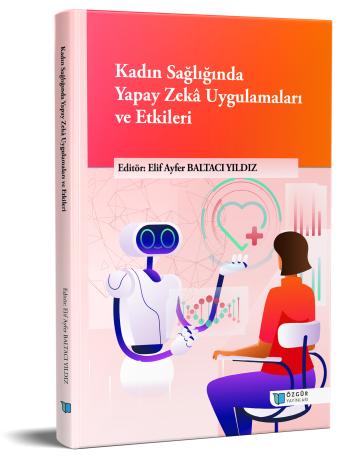
Innovative Artificial Intelligence Powered Applications in Women’s Health
Chapter from the book:
Baltacı Yıldız,
E.
A.
(ed.)
2026.
Applications and Impacts of Artificial Intelligence in Women's Health.
Synopsis
The use of artificial intelligence technologies in women’s health has been gaining increasing importance in recent years, in tandem with the digital transformation of healthcare services. AI-powered applications contribute to the faster, more accurate, and personalized execution of diagnostic, monitoring, treatment, and care processes at various stages of a woman’s life, including reproductive health, pregnancy, childbirth, the postpartum period, and menopause management. In particular, systems based on machine learning, deep learning, and big data analytics make it possible to identify high-risk pregnancies early on, assess fetal anomalies, manage infertility processes, and monitor menopause symptoms. In addition, through wearable technologies, mobile health applications, and digital decision support systems, women’s health data can be monitored in real time, and clinical decision-making processes are supported. Artificial intelligence applications also contribute to the early diagnosis of mental health issues such as postpartum depression and to increasing access to psychosocial support services. However, ensuring data security, adhering to ethical principles, mitigating algorithmic bias, and establishing clinical validity are of great importance for the effective and reliable use of these technologies. Overall, it is evident that AI-supported digital health technologies make significant contributions to transforming women’s health services into a more preventive, holistic, and patient-centered model.
How to cite this book
License

This work is licensed under a Creative Commons Attribution-NonCommercial 4.0 International License.
Published
DOI
Categories
Copyright (c) 2026 Elif Ayfer Baltacı Yıldız; Veysel Kızılarslan- Aycan Şahin- Leyla Sezgin- Elif Ayfer Baltacı Yıldız- Şükriye Şahin- Yasemin Özhanlı- Süheyla Demirtaş Alpsalaz- Rukiye Demir Dikmen