
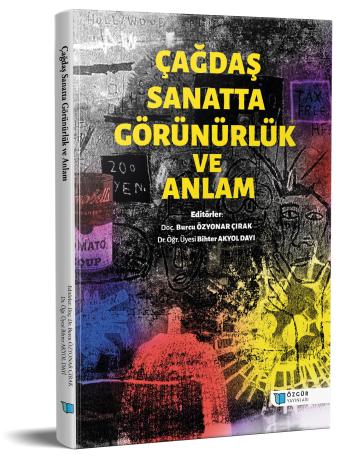
The Individual Beyond Art: A Viewer-Centered Artwork
Chapter from the book:
Akyol Dayi,
B.
&
Özyonar Çırak,
B.
(eds.)
2026.
Visibility and Meaning in Contemporary Art.
Synopsis
20th-century art witnessed the idealisation of modernism’s Notion of “cerating a new beginning”. In contrast, postmodernism, which emerged in opposition to this, rejected aesthetic fixity and, through the concepts it introduced, produced the dichotomy of ‘us and the other’. Furthermore, the changing social dynamics accompanying modernity have caused existential anguish in the individual. Experiences such as alienation, loneliness, rootlessness and statelessness have become concepts defining the contemporary subject. To overcome these crises, the concept of the “radican” proposed by Nicolas Bourriaud suggests rethinking the subject as a mobile, heterogeneous structure situated within diverse cultures and relationships.
This study examines the transformation that art has undergone alongside modernity, referencing Bourriaud’s concept of the “radikan” through an approach centred on a model of the spectator that transcends art. The research demonstrates that art has shifted from being a field based on the production of objects to a terrain where interpersonal relationships, encounters and experiences are produced. The aim of the study is to demonstrate that the feelings of alienation, rootlessness, individualisation and loneliness created by modernity in the individual can be transformed through the medium of art. In this context, the Situationist International emphasises that a work of art should not be evaluated solely in terms of its market value; it intertwines art with everyday life and signals the possibility of the viewer’s inclusion within the artwork. In contemporary examples, however, it is evident that artists have focused on the idea of amplifying feelings of closeness, connection, recognition, being recognised and acceptance for individuals through formations such as a parade, a restaurant project, an orchestra of postmen, a migrant football team and an ecological solidarity centre.
Consequently, the study reveals that contemporary art is moving towards a production philosophy centred on the viewer, built upon collective experience and coexistence. With this transformation, art is being redefined as a relational space that contributes to the individual’s social and psychological well-being.
How to cite this book
License

This work is licensed under a Creative Commons Attribution-NonCommercial 4.0 International License.
Published
DOI
Categories
Copyright (c) 2026 Bihter Akyol Dayi- Burcu Özyonar Çırak; Bihter Akyol Dayi- Burcu Özyonar Çırak- Buse Kızılırmak Çekinmez- Şükriye İnan Çalapkulu- Eda Seda Tosun- Gülşah Bayraktar- Gülşah Özdemir- Hatice Doğan- Sara Çebi