
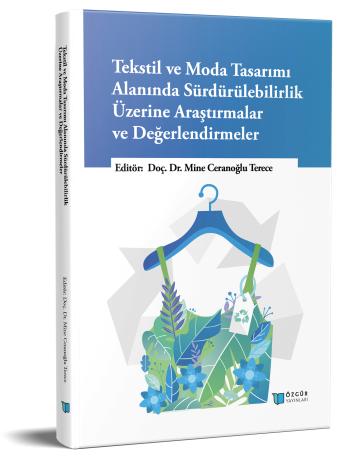
The Adaptation of the Traditional Plant Knitting Technique “Square Weave” to Fashion Design Through the Integration of Artificial Intelligence in the Context of Cultural Sustainability
Chapter from the book:
Ceranoğlu Terece,
M.
(ed.)
2026.
Research and Evaluations on Sustainability in Textile and Fashion Design.
Synopsis
This research examines the adaptation of the square weaving technique—considered part of the traditional art of plant-based weaving—to contemporary women’s jacket design within the context of cultural sustainability. Square weaving is a craft technique based on the principle of interlacing and interlocking horizontal and vertical plant-based strips to form square modules. The research aims to demonstrate that, whilst contributing to the preservation of this traditional craft technique as a form of production knowledge belonging to the past, it can also be regarded as a creative and transformative design element capable of being reimagined within contemporary fashion design. In this context, the study is structured around the themes of traditional arts, plant-based weaving, the square weaving technique, cultural sustainability, design-based research and AI-assisted fashion design. The Design-Based Research approach was employed in the methodology section, and the research process was conducted through the following stages: technical analysis, visual reference analysis, AI-assisted sketch production, variation development, revision, and design selection. Within the scope of the research, the square knitting technique was conceptualised through interlocking forms, small and large knitting scales, and open and closed knitting layout plans, and women’s jacket designs were developed using this technical framework. The findings indicate that the square weaving technique can be utilised as a design tool to determine the structure, volume, rhythm and silhouette of garments within contemporary fashion design processes, whilst also contributing to the formation of textures. The study highlights the necessity of evaluating traditional knowledge within the framework of cultural sustainability, whilst also arguing that its relevance can be maintained by reintroducing it into contemporary design practices and digital generative design processes.
How to cite this book
License

This work is licensed under a Creative Commons Attribution-NonCommercial 4.0 International License.
Published
DOI
Categories
Copyright (c) 2026 Mine Ceranoğlu Terece; Hülya Arabacı- Neslihan Demir- Merve Balkış- Emine Koca- Esra Enes- Nazan Özcan