
The Construction of Public Administration in the Early Republican Period: Centralization and the Establishment of the Modern State (1923-1946)
Chapter from the book:
Çetin,
M.
Ş.
(ed.)
2026.
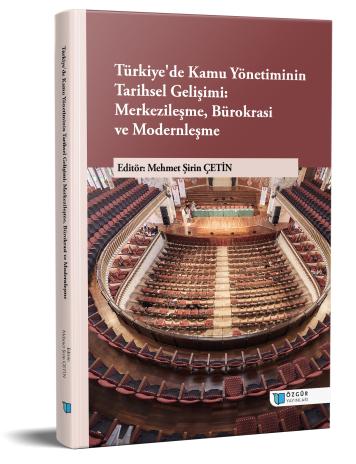
The Historical Development of Public Administration in Turkey: Centralisation, Bureaucracy and Modernisation.
Synopsis
This book chapter examines the establishment and development of public administration in Turkey during the early Republican period (1923-1946) through the lens of centralization, nation-state building, and the creation of modern state capacity. Instead of entirely rejecting the administrative legacy inherited from the Ottoman Empire, the Republican government reshaped it to align with the political and social goals of the new regime. Therefore, early Republican public administration emerged as a structure that simultaneously maintained the continuity of institutions inherited from the Ottomans and incorporated the transformations necessitated by the new understanding of the state. The chapter details how the legal basis of public administration was established through constitutional regulations. In particular, the transition from the 1921 Constitution, which granted a degree of autonomy to local governments, to the 1924 Constitution's unitary state model based on a strong central authority is considered a critical turning point in the shaping of public administration. This change aimed to increase the state's administrative capacity throughout the country and strengthen the central authority's control over the provinces. Within this framework, the governorship institution, provincial administration, and general inspectorates became the primary instruments for implementing the decisions of the central government in different regions of the country. Municipalities and village administrations played significant roles in the implementation of state policies at the local level, in addition to the provision of local services. Furthermore, state-owned economic enterprises were used as effective tools in achieving economic development goals; the direct intervention of the state in economic life expanded the scope of public administration. The single-party era organization also played an important role in maintaining political unity and ensuring that state policies reached all segments of society. The main argument of this chapter is that public administration in the early Republican period was not merely a technical structure providing public services. Public administration also functioned as a constitutive mechanism that guided social transformation, created a new understanding of citizenship, organized economic development, and strengthened national unity. In this respect, public administration is considered a cornerstone of the Republic's modernization and state-building process; it played a central role in achieving the social and political goals of the new regime. Therefore, early Republican public administration is of great importance for understanding the formation of the modern state structure in Turkey.
How to cite this book
License

This work is licensed under a Creative Commons Attribution-NonCommercial 4.0 International License.
Published
DOI
Categories
Copyright (c) 2026 Mehmet Şirin Çetin; Yusuf Muyan- Mustafa Fahri Mirhanoğulları- Mehmet Şirin Çetin- Serdar Şenol- Abdurrahman Turgut- Zekerya Çavuş- Selami Özkan- Mustafa Gökberk Ertan