
A Unifying Framework for Objective Criteria Weighting in Multi-Criteria Decision Making: Normalisation Invariance, Degeneracy and Selection
Chapter from the book:
Yılmaz,
N.
(ed.)
2026.
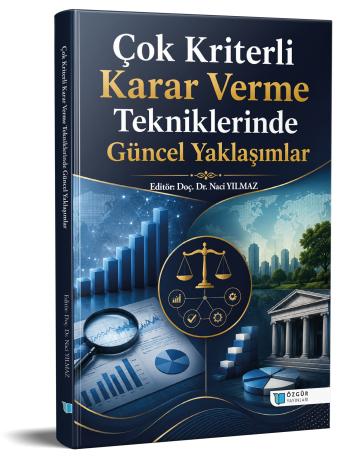
Current Approaches in Multi-Criteria Decision Making Techniques.
Synopsis
Objective weighting methods derive criterion importances directly from a decision matrix, without eliciting preferences from a decision maker. A large and growing family of such methods is now in routine use, yet they are often studied empirically (applied to a dataset and compared through the correlation of the resulting weights) or surveyed descriptively. This chapter takes a different, analytical route. It places seven widely used objective methods (the standard deviation method, the coefficient of variation, the Shannon entropy weight method, CRITIC, MEREC, LOPCOW and CILOS, together with the composite IDOCRIW) inside a single three-stage decomposition: a normalisation, a per-criterion dispersion or information functional and an optional de-correlation or structural adjustment, followed by a sum-to-one normalisation. Within this framework two structural properties are established with short proofs and counterexamples. First, a normalisation-invariance result classifies which methods return identical weights when the input is sum-, vector- or max-normalised: the entropy, coefficient-of-variation, LOPCOW, MEREC and CILOS weights are invariant to this choice, whereas the standard deviation and CRITIC weights are not in general, because their dispersion term scales with the column. Second, a degeneracy result identifies the inputs on which each method returns a zero weight, an undefined weight or fails to be well-defined; in particular, under the stated assumptions, a constant criterion receives zero weight in SD, CV, EWM and MEREC, whereas CRITIC, LOPCOW and CILOS are not well-defined. A worked example illustrates both results and a further contrast: the methods can encode different notions of what “important” means, so the same near-constant criterion can receive either the smallest or the largest weight. The analysis yields a property-based taxonomy and a compact reporting-and-selection protocol for applied work.
How to cite this book
License

This work is licensed under a Creative Commons Attribution-NonCommercial 4.0 International License.
Published
DOI
Categories
Copyright (c) 2026 Naci Yılmaz; Doğan Şengül- Bora Kurtuluş- Hande Eren- Esra Aksoy Erzurumlu- Naci Yılmaz