
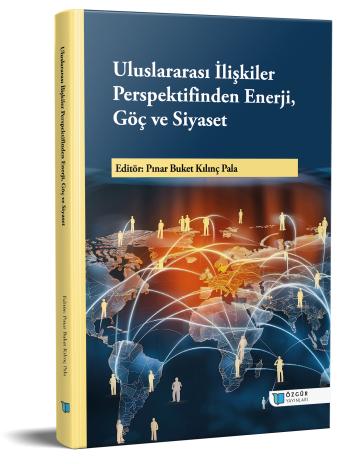
From Geopolitical Risk to Risk Geopolitics: Rethinking Geopolitics under Risk Society Conditions
Chapter from the book:
Kılınç Pala,
P.
B.
(ed.)
2026.
Energy, Migration And Politics From An International Relations Perspective.
Synopsis
This chapter theoretically discusses the transition from the “geopolitical risk” approach, which is dominant in classical geopolitical thought, to the “geopolitics of risk” approach, which places risk at the centre of analysis. In classical geopolitics, space is often regarded as the source of risk; the geographical location, borders, neighbours, resources & strategic features of particular regions generate threats or opportunities for states. By contrast, the geopolitics of risk goes beyond treating risks as security problems arising from specific places & argues that they are relational processes that reorganise space, actors, scales, forms of governance & power relations. Drawing on Beck’s risk society & Giddens’s late modernity debates, the chapter argues that geopolitics cannot be confined to fixed notions of space, borders & sovereignty; contemporary risks should instead be evaluated through uncertainty, interdependence, vulnerability, resilience & multi-scalar governance. Accordingly, the geopolitics of risk operates along four analytical lines: risk makes particular spaces vulnerable, authorises certain actors, legitimises specific forms of intervention & connects local, national, regional & global scales. Thus, the geopolitics of risk is positioned as a theoretical approach that complements classical geopolitics’ region-, border- & domination-centred reading by jointly examining the relations between risk, space & power.
How to cite this book
License

This work is licensed under a Creative Commons Attribution-NonCommercial 4.0 International License.
Published
DOI
Categories
Copyright (c) 2026 Pınar Buket Kılınç Pala; Mehmet Nur Çelikaslan- Muharrem Koz- Engin Selçuk- Fatih Demircioğlu- Vildan Meydan- Serkan Kırkeser