
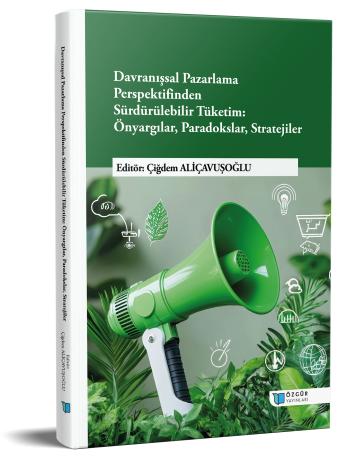
Cognitive Biases in Sustainable Consumption: Types and Effects
Chapter from the book:
Aliçavuşoğlu,
Ç.
(ed.)
2026.
Behavioral Marketing Perspectives on Sustainable Consumption: Biases, Paradoxes, and Strategies.
Synopsis
Sustainable consumption is considered a critical behavioral domain for achieving environmental, economic, and social sustainability. However, pro-environmental attitudes do not always translate into sustainable behaviors, leading to the well-documented attitude–behavior gap. This chapter examines the role of cognitive biases in sustainable consumption from a behavioral economics perspective. First, the theoretical foundations of sustainable consumption are discussed, followed by an analysis of cognitive biases and their influence on decision-making processes. The chapter explores how biases such as representativeness, availability, loss aversion, status quo bias, confirmation bias, social proof bias, and cognitive dissonance shape sustainable consumption decisions. In addition, the effects of cognitive biases in green marketing practices are evaluated, with particular attention to greenwashing, eco-labels, and environmental communication strategies. The findings suggest that cognitive biases constitute significant barriers to sustainable consumption behaviors; however, their effects can be mitigated through appropriate behavioral interventions and policy instruments. Social norm-based approaches, default options, environmental labeling systems, digital nudging tools, and awareness programs are highlighted as effective mechanisms for promoting sustainable consumption. Understanding the psychological dimensions of consumer decision-making is essential for designing more effective sustainability policies and encouraging long-term behavioral change.
How to cite this book
License

This work is licensed under a Creative Commons Attribution-NonCommercial 4.0 International License.
Published
DOI
Categories
Copyright (c) 2026 Çiğdem Aliçavuşoğlu; Çiğdem Aliçavuşoğlu- Murat Aksu- Özgür Kuru- Candan Özgün Ayar- Halime Büşra Yaşar- Muhammed Furkan Tan- Taner Eken