
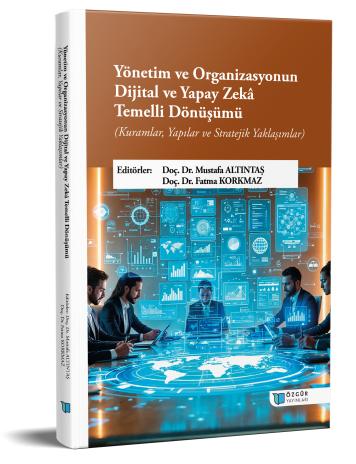
Digital and Artificial Intelligence-Based Transformation of Management and Organization: Theories, Structures, and Strategic Approaches
Synopsis
Rapid advances in digitalization and artificial intelligence technologies are fundamentally transforming the structures, management approaches, decision-making processes, and stakeholder relationships of contemporary organizations. The scale and scope of technological change have made it insufficient to view digital transformation merely as the adoption of new technologies or the digitization of existing processes. Today, organizations must simultaneously consider a wide range of factors, including structural flexibility, strategic alignment, digital competencies, ethical responsibility, sustainability, trust, resilience, and human-centered management. In this context, Digital and Artificial Intelligence-Based Transformation of Management and Organization (Theories, Structures, and Strategic Approaches) offers a multidisciplinary perspective that examines the changes brought about by the digital age in the field of management and organization from diverse theoretical and practical perspectives.
The chapters included in this edited volume cover a broad spectrum of topics, ranging from the transformation of organizational structures in the digitalization process and the rebuilding of organizational trust to e-leadership and digital leadership approaches, data-driven decision-making processes, the effects of artificial intelligence on strategic management and competitive advantage, sustainable leadership, and digital competencies. The volume also provides in-depth discussions of contemporary issues such as value creation in AI-enabled service ecosystems, experience design and operational intelligence in tourism businesses, change management and organizational resistance in the digital transformation process, organizational resilience and crisis management under conditions of uncertainty, ethics and corporate governance in the age of artificial intelligence, as well as behavioral transformation and digital nudging strategies.
Particular attention is also devoted to the human and organizational dimensions of digital transformation. Factors such as organizational resistance to change, employees’ adaptation to new technologies, transparent communication, training, and leadership support are evaluated in terms of the sustainability of transformation. In addition, the volume emphasizes the need to reconsider organizational resilience and crisis management through digital and AI-supported approaches under conditions of polycrisis and high uncertainty. Hybrid decision-making mechanisms that integrate human judgment with the analytical capabilities of artificial intelligence are addressed as one of the key elements of future approaches to organizational resilience.
The ethical and governance challenges arising from the widespread adoption of artificial intelligence also constitute major areas of discussion in this volume. Issues such as algorithmic bias, transparency, explainability, accountability, data privacy, and cybersecurity are examined from a corporate governance perspective, highlighting the need for responsible AI practices to be supported by human oversight and stakeholder participation. Furthermore, behavioral transformation within the discipline of public administration is explored through digital nudging strategies and AI-supported governance practices, with particular attention to the effects of digitalization on citizen-state relations.
This volume aims to serve as a contemporary reference source for academics, graduate students, researchers, and practitioners working in the fields of management and organization, business administration, strategic management, public administration, leadership, tourism, organizational behavior, management information systems, and related areas of the social sciences. The distinctive contribution of the book lies in its treatment of digital transformation and artificial intelligence not merely as technical changes, but as multidimensional phenomena encompassing organizational structures, human behavior, leadership, strategy, sustainability, ethics, and governance. Drawing on the expertise and original contributions of chapter authors from diverse disciplines, this work provides a comprehensive and multidimensional assessment of the transformation generated by the digital age in the field of management and organization.
We would like to take this opportunity to express our sincere gratitude to all chapter authors whose scholarly expertise and valuable contributions made this volume possible, as well as to everyone involved in the preparation process. We hope that this work will contribute to the academic literature and prove beneficial to researchers, students, managers, and all relevant stakeholders.
Assoc. Prof. Dr. Mustafa ALTINTAŞ - Assoc. Prof. Dr. Fatma KORKMAZ
Editors
Chapters
How to cite this book
License

This work is licensed under a Creative Commons Attribution-NonCommercial 4.0 International License.
Published
ISBN
DOI
Statistics
Categories
Copyright (c) 2026 Mustafa Altıntaş- Fatma Korkmaz; Abdulsamet Duran- Burcu Atar- Musa Özata- Aslı Öztürk- Uğur Dagtekin- Ahmet Kâmil Kabakuş- Zümral Gültekin- Kevser Küçük Can- Mustafa Atsan- Mehmet Ertem- Erol Tekin- Benazir Öztürk