
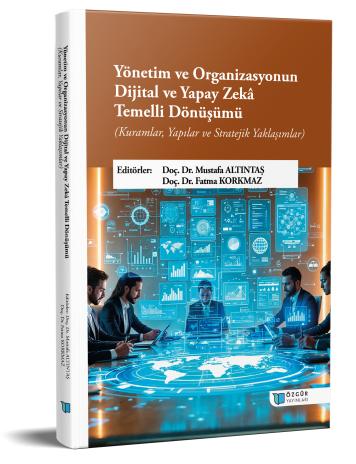
Change Management in the Digital Transformation Process: Organizational Resistance, Adaptation, and Transformation Models
Chapter from the book:
Altıntaş,
M.
&
Korkmaz,
F.
(eds.)
2026.
Digital and Artificial Intelligence-Based Transformation of Management and Organization: Theories, Structures, and Strategic Approaches.
Synopsis
Digital transformation in today’s business world refers not only to technological renewal but also to a fundamental restructuring of organizational culture and strategic structure. Simply developing new software or introducing new technological devices into the organization is not sufficient on its own. This is because the success of this process depends not on the technological infrastructure but on the effectiveness of change management-an approach centered on people. Unless transparent and two-way communication mechanisms are implemented with employees during the change process, it will be difficult to successfully implement the transformation. In this study, organizational alignment, resistance mechanisms, and transformation models are addressed as key pillars for ensuring the sustainability of the innovations brought by digitalization. Organizational alignment aims to ensure that the digital vision is adopted as a shared goal across all departments and employee levels. Integrating strategic goals with individual competencies removes barriers to transformation. However, the greatest obstacle encountered in this process is organizational resistance. Accordingly, the study addresses the literature on organizational resistance. Fear of the unknown, concerns about job security, and attachment to established work practices lead employees to adopt a defensive stance toward new systems. Managing this resistance is possible through a transparent communication strategy, continuous training support, and leadership taking ownership of the process at every stage. In light of this information, this study examines organizational resistance, organizational adaptation, and transformation models in detail, drawing from the literature on digital transformation and change management. The study addresses the barriers to transformation and proposes solutions to overcome them. Furthermore, by placing the human factor at the center of the digital transformation journey, it presents a holistic perspective on the evolution organizations must undergo.
How to cite this book
License

This work is licensed under a Creative Commons Attribution-NonCommercial 4.0 International License.
Published
DOI
Categories
Copyright (c) 2026 Mustafa Altıntaş- Fatma Korkmaz; Abdulsamet Duran- Burcu Atar- Musa Özata- Aslı Öztürk- Uğur Dagtekin- Ahmet Kâmil Kabakuş- Zümral Gültekin- Kevser Küçük Can- Mustafa Atsan- Mehmet Ertem- Erol Tekin- Benazir Öztürk