
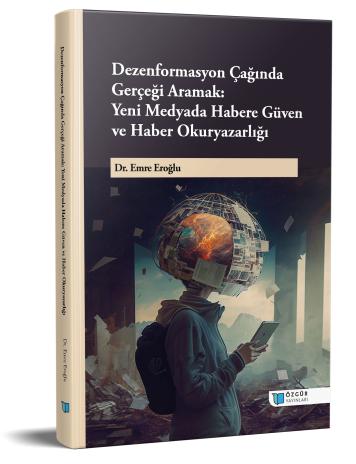
Seeking the Truth in the Age of Disinformation: Trust in News and News Literacy in New Media
Synopsis
Today, new media, which has become the primary source of information and news, also brings with it the problem of the rapid spread of false/misleading information. In new media, where speed, immediacy, and interactivity are prominent features, messages circulate very quickly, and false and misleading information spreads at the same speed. Assessing the reliability and accuracy of information and news disseminated on social media platforms plays a critical role in preventing information pollution. In this context, the main objective of this study is to examine the extent to which university students trust news and information in new media, especially social media, and how their news media literacy levels relate to this trust. A mixed-methods approach was adopted in the study. While two scales related to trust and news literacy were used in the quantitative dimension, in-depth information was obtained through semi-structured interviews in the qualitative dimension. The interpretation of the quantitative and qualitative data obtained is presented together. According to the research findings, social media has been identified as the primary source of news for students. Students' level of trust in social media content was found to be moderate, while their news media literacy levels were found to be close to high. Increasing age and education level (especially postgraduate) brought with it an increase in the verification of information and news literacy levels, and showed that they engaged in more critical questioning behavior. Correlational findings show that as news media literacy levels increase, students' tendency to verify information strengthens, their awareness of information pollution and disinformation increases, and they place greater trust in institutional sources. Qualitative findings reveal that students are generally aware of the risk of disinformation, use different verification methods, and place greater trust in professional media organizations. However, it has also been understood that students are influenced by ideological and emotional factors when evaluating news, leading them to deviate from objective evaluation and experience cognitive dissonance. In this context, it is also seen that the post-truth phenomenon has an effect on students. The "distrust" reflected in the surveys is defined as a "conscious strategy" in qualitative interviews. Therefore, rather than abandoning social media because they do not trust it, students adopt a "trust and verify" approach. As education and age increase, this strategy is seen to transform into a more systematic and conscious research behavior.
How to cite this book
License

This work is licensed under a Creative Commons Attribution-NonCommercial 4.0 International License.
Published
ISBN
DOI
Statistics
Categories
Copyright (c) 2026 Emre Eroğlu; Nesrin Akıncı Çötok