
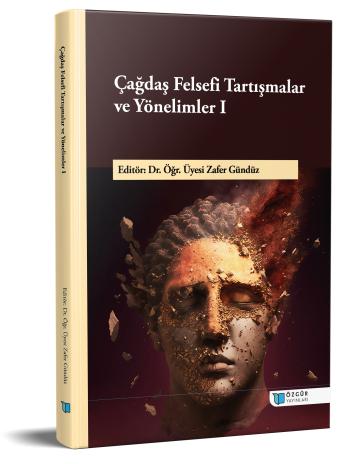
Contemporary Philosophical Debates and Perspectives I
Synopsis
The history of philosophy is a continuous reflection of thought upon itself. In the contemporary period, however, this reflection extends beyond the classical boundaries of ontology and epistemology to encompass a wide range of human concerns — ethics, politics, language, culture, technology, law, artificial intelligence, and art. This volume aims to explore the major directions and debates of 21st-century philosophy through an interdisciplinary lens.
Contemporary Philosophical Debates and Directions I represents a collective effort to rethink the transformation of classical philosophical problems in the modern world, as well as the emergence of new philosophical domains. Each chapter in this book engages with a specific contemporary issue, employing distinct conceptual tools and methodological perspectives to reinterpret it within today’s intellectual landscape.
For instance, the chapter titled “Reappraising Foucault's Analysis of Authorship in the 21st Century: AI Authorship” examines the transformation of the concept of authorship in the age of artificial intelligence through the lens of Foucault’s analyses of discourse and subjectivity, thus offering a critical response to the ethical, aesthetic, and epistemic questions raised by technology. Similarly, “Dialectics in Hegel and Marx: A Comparative Analysis of Idealist and Materialist Interpretations of Method” investigates how Hegel’s and Marx’s dialectical systems converge and diverge, tracing their respective philosophical and political implications.
The section “Logical Monism and the ‘True’ Logic” deepens the discussion within the philosophy of logic by questioning the notion of a singular “true” logic and examining its theoretical boundaries. “Hermeneutics Contrasts: Theory of Understanding in Different Views” reconsiders the hermeneutical project by emphasizing the roles of language, culture, and text in the process of understanding. Likewise, “Perspectives of Social Theorists on Power” offers a comparative reading of diverse theories of power, showing how power functions as both a productive and transformative force. Finally, “An Epistemological Approach to the Legal System” proposes a philosophical inquiry into the formation, justification, and coherence of legal knowledge, arguing for the development of a contemporary legal epistemology.
This volume is not merely a compilation of contemporary philosophical discussions but also a space of intellectual convergence, where distinct traditions, thinkers, and disciplines intersect. Each contribution seeks to shed light not only on its own thematic focus but also on the broader philosophical atmosphere of our time.
Ultimately, Contemporary Philosophical Debates and Directions I aims to demonstrate how philosophy continues to serve as a guide in the rapidly transforming intellectual environment of the present, inviting readers not only to knowledge but also to a deeper critical awareness of thought itself.
Chapters
How to cite this book
License

This work is licensed under a Creative Commons Attribution-NonCommercial 4.0 International License.
Published
ISBN
DOI
Statistics
Categories
Copyright (c) 2025 Zafer Gündüz; Merve Arslan- Mustafa Polat- Muzaffer Gül- Engin Daşlı- Erol Uyanık