
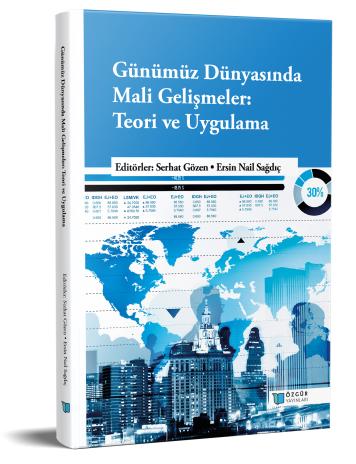
The Relationship Between Public and Private Social Expenditures and Economic Growth: An Analysis of Selected OECD Countries
Chapter from the book:
Gözen,
S.
&
Sağdıç,
E.
N.
(eds.)
2025.
Fiscal Developments in the Contemporary World: Theory and Practice.
Synopsis
Public social expenditures represent a topic that has mostly been evaluated in the literature in the context of combating income inequality and poverty. Alternatively, they have been assessed as automatic stabilizers based on fiscal policies. Discussions are ongoing in the literature that the composition of public social expenditures plays an important role in policy design in terms of reducing social inequality and encouraging economic growth. However, there is not enough empirical evidence to support this view. On the other hand, studies in literature mostly do not take private social expenditure into account. The purpose of this study is to fill a gap in this field and to evaluate the effect of social expenditure on economic growth in OECD countries in terms of public and private sector social expenditure types. With this aim, the long-term effect of public social expenditures and private social expenditures on economic growth was analyzed with panel data analysis on the basis of 36 OECD countries between the years 2000-2021. The findings obtained from this study show that public social expenditures and private social expenditures have a negative effect on economic growth in the long run. Besides this, causality test results show that there is a one-way causality relationship from public social expenditures to economic growth, and a two-way causality relationship between private social expenditures and economic growth.
How to cite this book
License

This work is licensed under a Creative Commons Attribution-NonCommercial 4.0 International License.
Published
DOI
Categories
Copyright (c) 2025 Serhat Gözen- Ersin Nail Sağdıç; Göksel Karaş- Hasan Hüseyin Aleçakır- Hatice Dayar- İlhan Korkmaz- Güner Tuncer- Ersin Nail Sağdıç- Fazlı Yıldız- Ebru Yalçın- Süleyman Emre Özcan- Özer Özçelik- Hatice Arslanparçası- Serhat Gözen- Ebru Karaş- Fatma Alkan- Gülistan Altıok- Meltem İrteş Gülşen - Betül Hayrullahoğlu