
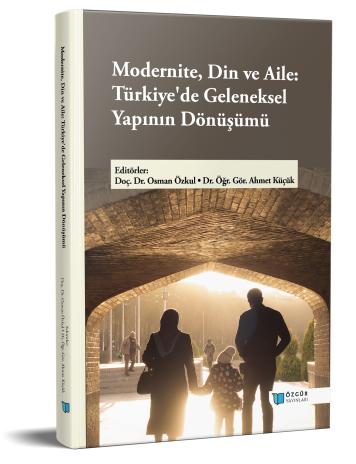
The Change of Name Culture in Turkish Society: An Analysis in the Context of Pitirim Sorokin's Cultural Typology
Chapter from the book:
Özkul,
O.
&
Küçük,
A.
(eds.)
2025.
Modernity, Religion, and Family: The Transformation of Traditional Structure in Türkiye.
Synopsis
This article examines the historical transformation of naming culture in Turkish society through Pitirim Sorokin’s cultural typology. Sorokin’s sensate, idealistic, and ideational cultural types offer a significant theoretical framework for understanding how social values, symbols, and meaning systems change over time. Naming traditions among Turks have historically served not only as personal identifiers but also as cultural, religious, and ideological markers. During the Ottoman period, religious and traditional themes predominated. Following the foundation of the Republic, processes of modernization and Westernization led to the increasing influence of sensate culture, spreading secular and Western-oriented names. In recent decades, popular culture—particularly television series, social media, and celebrity culture—has shaped newborn naming trends. Conversely, there has also been a resurgence of traditional and religious names in some communities. Drawing on TUIK statistics (2018–2025) and relevant scholarly literature, this study analyzes the multilayered transformation of Turkish naming culture and relates it to Sorokin’s cultural theory.
How to cite this book
License

This work is licensed under a Creative Commons Attribution-NonCommercial 4.0 International License.
Published
DOI
Categories
Copyright (c) 2025 Osman Özkul- Ahmet Küçük; Osman Özkul- Fatma Göl- Nurenda Coşkun- Yasemin Yaşar- Abdullah Adıgüzel- İlhan Karaca- Zeynep Toprak- Fatih Aydın- Ahmet Küçük- İbrahim Kaygusuz- Hakkı Kalaycı- İshak Torun