
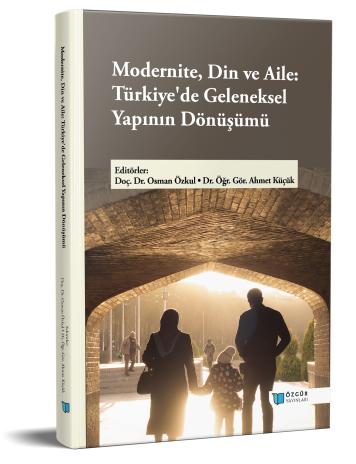
Family as an Element of Social Structure
Chapter from the book:
Özkul,
O.
&
Küçük,
A.
(eds.)
2025.
Modernity, Religion, and Family: The Transformation of Traditional Structure in Türkiye.
Synopsis
The family represents a fundamental and enduring institution within every society. It not only nurtures individuals from birth but also reflects and shapes broader social structures. In sociological terms, the family acts as both a mirror and microcosm of society, embodying social values, norms, and institutional transformations. This chapter conceptualizes the family as a core element of the social structure and explores its evolving functions, typologies, and historical transitions, particularly within the context of Turkish society. By employing classical and contemporary sociological theories—including structural functionalism, symbolic interactionism, and Anthony Giddens' structuration theory—the chapter examines how family structures adapt to macro-level changes such as industrialization, urbanization, and globalization. It highlights the dual role of the family: as a transmitter of cultural values and as an institution undergoing transformation. Furthermore, the work explores the interaction between the family and other social institutions such as education, religion, and the economy. A comparative-historical framework is used to analyze the transformation from extended patriarchal families to modern nuclear families and beyond, situating the Turkish experience within global patterns. The study also discusses the ideological, economic, and political pressures shaping contemporary family forms and the implications of these changes for social cohesion and identity. The chapter concludes that although the family has undergone functional shifts over time, its psychological and cultural relevance remains irreplaceable. It calls for a multidimensional and non-reductionist understanding of family change, resisting linear or overly optimistic narratives of modernity.
How to cite this book
License

This work is licensed under a Creative Commons Attribution-NonCommercial 4.0 International License.
Published
DOI
Categories
Copyright (c) 2025 Osman Özkul- Ahmet Küçük; Osman Özkul- Fatma Göl- Nurenda Coşkun- Yasemin Yaşar- Abdullah Adıgüzel- İlhan Karaca- Zeynep Toprak- Fatih Aydın- Ahmet Küçük- İbrahim Kaygusuz- Hakkı Kalaycı- İshak Torun