
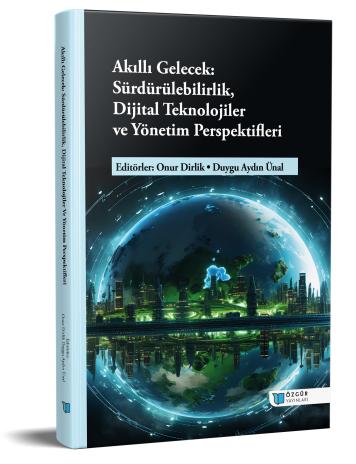
Smart Future: Sustainability, Digital Technologies, and Management Perspectives
Synopsis
Humanity is witnessing a critical turning point in a rapidly changing world. The complexity of the global challenges we face reveals a simple truth: traditional solutions are no longer adequate. From the climate crisis to resource scarcity, from social inequality to the pressures of urbanization, societies are now compelled to make consequential decisions across multiple domains. Yet these challenges also bring a historic opportunity—the opportunity to build a smarter, more sustainable, and more equitable future.
This book examines precisely this intersection. “Smart Future” refers not only to technological advancement, but to a holistic vision in which such advancement is integrated with governance approaches centered on long-term well-being and ecological balance. Technology can no longer be perceived merely as a tool for efficiency; it must be recognized as a critical catalyst for achieving sustainability goals.
We are living in an era defined by the Fourth Industrial Revolution—a profound transformation in which digital technologies blend the physical, biological, and digital realms. Artificial intelligence, the Internet of Things (IoT), big data, and blockchain are radically reshaping every sector, from energy production and supply chain management to smart cities and healthcare services. These technologies enable what was once impossible: real-time optimization of resource use, precise measurement of environmental impact, and the creation of more transparent and participatory governance models. However, technology alone is not a solution. Realizing the full potential of these transformative tools requires visionary governance. Governance here is understood from an expansive perspective, encompassing not only corporations but also nations, cities, and international institutions. Building a Smart Future depends on a shift in mindset—from short-term profit-driven decisions to long-term social and environmental value creation, supported by ethical principles and multi-stakeholder collaboration.
In this context, the primary aim of the book is to illuminate the complex and critical relationship among sustainability, digital technologies, and governance. Beyond offering theoretical discussion, the book provides strategic perspectives, actionable models, and contemporary case studies that equip readers with practical, implementable insights.
The first chapter, written by Onur Dirlik and titled “Smart Future: Society 5.0 and Businesses,” offers an in-depth examination of Society 5.0, the pinnacle of technological evolution. Originating in Japan, this Super Smart Society framework positions digital transformation not merely as a tool for economic efficiency, but as a human-centered and sustainable societal design aimed at addressing challenges such as aging populations, environmental degradation, and social inequality.
The chapter clarifies the critical distinctions between Society 5.0 and concepts such as Industry 4.0 and Industry 5.0, highlighting the shift in focus from the production line to society as a whole (health, education, public administration). From a business perspective, the chapter argues that digitalization is necessary but insufficient on its own, calling attention to the strategic, cultural, and ethical transformation that companies must undertake. Issues such as data-driven governance, the need for T-shaped professionals, and the role of environmental, social, and governance (ESG) criteria in shaping new competitive advantages are examined in detail. By presenting application areas such as smart manufacturing, personalized healthcare, and smart cities—alongside examples relevant to the Turkish context—the chapter outlines a roadmap for businesses seeking to become sustainable ecosystem actors that generate social value, offering readers a comprehensive lens through which to understand the paradigm shift introduced by Society 5.0.
In the second chapter, Yücel Türker addresses three fundamental pillars that are reshaping contemporary business strategies: artificial intelligence, big data analytics, and sustainability strategies. The chapter demonstrates that sustainability has moved beyond a purely environmental concern to become central to long-term competitiveness, framed around the triple bottom line of environmental, social, and economic performance. Big data provides vast amounts of information sourced from sensors, IoT devices, and digital transactions, while artificial intelligence transforms this data into meaningful insights—ranging from energy efficiency forecasting to emissions tracking and supply chain transparency. This integration turns sustainability into a real-time managerial component embedded directly into organizational systems rather than a mere reporting obligation.
The third chapter, authored by Duygu Aydın Ünal, examines the shift within the marketing discipline from traditional sustainability, which is grounded in minimizing harm, to regenerative marketing, which actively seeks to restore ecological and social systems. This emerging paradigm positions businesses not as isolated economic units but as embedded systems that operate in mutual interdependence with society and nature. The chapter critiques the limitations of sustainability practices that predominantly aim to slow degradation (net-zero) and instead advocates for a regenerative mindset in which businesses generate net-positive impact by enhancing natural and social capital. This approach necessitates the creation of multi-stakeholder value and the strengthening of biodiversity and community well-being.
The fourth chapter, “Sustainable Tourism: Conceptual and Applied Perspectives,” written by Ceylan Alkan, offers a comprehensive analysis of sustainable tourism—a concept that secures the long-term viability of the tourism sector amid its increasingly visible environmental and socio-cultural impacts. The conceptual framework addresses the environmental, economic, and socio-cultural dimensions of sustainability, emphasizing the need to protect natural resources and safeguard the quality of life of local communities. Central to the chapter is the concept of carrying capacity, a critical tool for preventing overtourism. The chapter also highlights the transformative role of technology in achieving sustainability goals. Smart destinations, data-driven management systems, and environmental monitoring technologies (drones, sensor networks) enable real-time monitoring of carrying capacity and crowding risks. Additionally, the chapter explains how renewable energy systems and digital certification practices enhance environmental performance and transparency in tourism operations. Ultimately, it argues that sustainable tourism can succeed only through the integrated application of technology, robust governance, and stakeholder participation.
The final chapter, authored by Aslıhan Kıymalıoğlu, focuses on digital nudging as an effective mechanism for promoting sustainable consumption in today’s increasingly digital consumer environments. Drawing on key principles of behavioral economics, the chapter seeks to bridge the well-known intention–behavior gap in online decision-making processes. Digital nudging refers to a choice architecture that guides consumers toward more environmentally friendly actions through interface design elements—without restricting their freedom of choice. The empirical study presented in the chapter shows that both default and social-norm nudges exert similar and significant positive effects on consumers’ preferences for organic products.
Chapters
How to cite this book
License

This work is licensed under a Creative Commons Attribution-NonCommercial 4.0 International License.
Published
ISBN
DOI
Statistics
Categories
Copyright (c) 2025 Onur Dirlik- Duygu Aydın Ünal; Onur Dirlik- Yücel Türker- Duygu Aydın Ünal- Ceylan Alkan- Aslıhan Kıymalıoğlu