
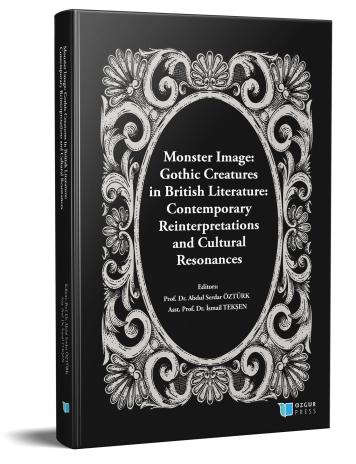
Monster Image: Gothic Creatures in British Literature Contemporary Reinterpretations and Cultural Resonances
Synopsis
Monsters emerge as confined figures between the pages that are kept at a distance from the reader through the boundaries of an alternative dimension. They constantly test this comfort zone through an artifice that is readily inclined to transform fear into pleasure. Within this framework, such creatures are aligned with the concept of aesthetic fear, frightening and entertaining their audience from a position of safe detachment. The distance that emerges between the monster and the reader is proportionally insurmountable. Prevented by a mimetic barrier from infiltrating everyday life, these wild figures function as fantastic typologies; yet, upon close reading, it becomes evident that the fear they generate positions them as representatives of an alternative dimension of meaning.
For instance, although Frankenstein’s celebrated creature is animated through electrification and presented as a grotesque aberration of creation, the true source of terror embedded within the text does not reside in the monster’s physical existence. Rather, it emerges from the quietly but deliberately articulated anxieties surrounding post-mortem existence, the notion of the afterlife, unresolved questions, and the transgression of uncanny boundaries. Even if the monster does not exist in a literal sense, it remains alive through the fears it represents, exerting tangible influence upon everyday life.
This dynamic can be aptly illustrated by the image of a skull inscribed on an electric pole. Observers are not unsettled by the skull as an object in itself; rather, they respond to the lethal danger it signifies and accordingly exercise caution. In a similar manner, this book aims to examine the fears embodied by monsters in British literature, drawing on the same semiotic mechanism as the warning symbol on the electric pole, and to trace their resonances in the contemporary world.
It is at this juncture that aesthetic fear yields to ontological fear. Artistic representation begins to illuminate existential truths; pleasure and suspense are transformed into caveats, functioning as instruments through which both society and the individual are compelled to confront themselves. When the book is closed, the monster retreats back into the pages and disappears, yet the fear it signifies continues to live on within the reader’s world. The present academic study aims precisely to delineate and identify the contours of this enduring fear.
Assistant Prof. Dr. İsmail TEKŞEN
Chapters
How to cite this book
License

This work is licensed under a Creative Commons Attribution-NonCommercial 4.0 International License.
Published
ISBN
DOI
Statistics
Categories
Copyright (c) 2025 Abdul Serdar Öztürk- İsmail Tekşen; Ferhat Ordu- Murat Karakaş- Ali Kubat- Selma Parlakay Topbaş- Afranur Yılmaz- Gözde Begüm Mızrak- Ayça Gülünay- Mustafa Canlı- Asım Aydın- Abdullah Boyar- Gökhan Tugay Köksal- Zeliha Kuruducu- Ömer Özdemir- Nihal Topcu- Lokman Şehitoğlu- Tuba Aydan- İsmail Tekşen