
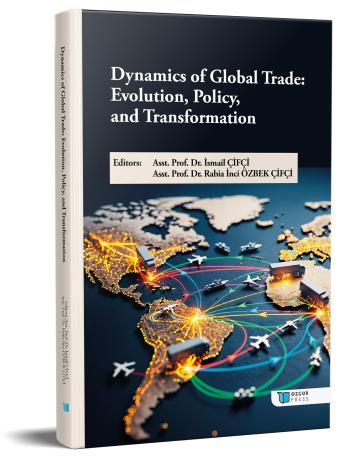
Dynamics of Global Trade: Evolution, Policy, and Transformation
Synopsis
International trade is a dynamic force that has facilitated cultural and technological interaction between nations for centuries and significantly impacted their welfare. As we leave the first quarter of the 21st century behind, the global economy is undergoing one of the most complex transformation processes in history. While the global economy experiences the elimination of borders in international trade thanks to digitalization, artificial intelligence, high technology, advancements in communication and transportation, and deep global value chains on the one hand; on the other, it is witnessing trade wars and protectionist trends. The liberal trade order, established after World War II and viewing interdependence as the guarantee of peace, is giving way to a new era characterized by increasing geoeconomics competition, strategic protectionism, and rising digital walls. This book, titled Dynamics of Global Trade: Evolution, Policy, and Transformation, examines a broad scope ranging from the historical roots of global trade to modern digital transformation, and from protectionist policies to the fight against poverty.
The study emphasizes how digital transformation has radically changed the nature of trade, how artificial intelligence and big data analytics have made global value chains more flexible and transparent, and how global trade has entered a new phase of trade wars with the 'China Shock' and strategic protectionist moves initiated by the USA. One of the distinctive features of the work is its demonstration that trade is not merely a technical process, but that cultural dynamics and institutional structure also hold importance in foreign trade. Furthermore, the thesis presented in the book-that the impact of globalization on poverty is not automatic but dependent on institutional capacity-enhances the socio-economic depth of the study. Finally, the relationship between growth and the current account balance specifically within the MINT countries (Mexico, Indonesia, Nigeria, Turkey), along with Turkey's search for new alliances such as the Shanghai Cooperation Organization, offers current policy recommendations for emerging markets. This book aims to serve as a guiding resource for researchers, policymakers, and the business world in the face of increasing Trade Policy Uncertainty in our world where global value chains have become interdependent.
We extend our sincerest thanks to all our chapter authors who contributed to the realization of this book and added value to the literature with their meticulous work, and to the publishing house for their support during the publication process.
Chapters
How to cite this book
License

This work is licensed under a Creative Commons Attribution-NonCommercial 4.0 International License.
Published
ISBN
DOI
Statistics
Categories
Copyright (c) 2025 İsmail Çifçi- Rabia İnci Özbek Çifçi; İsmail Çifçi- Rabia İnci Özbek Çifçi- Ezgi Babayiğit- Şahin Çetinkaya- Cansu Fırtına- Ercan Yaşar- Merve Esra Gülcemal- Gülşah Adam- Hüseyin Ersöz- Özer Özçelik- Murat Mere