
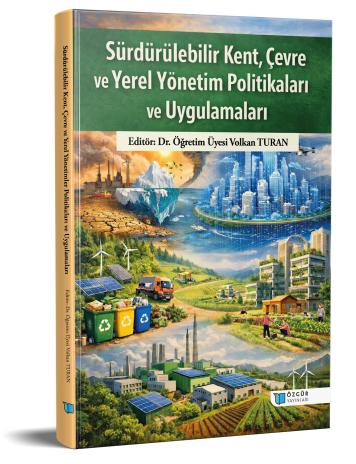
Sustainable City, Environment and Local Government Policies and Practices
Synopsis
Cities are not only spatial reflections of humanity's economic, social, and cultural accumulation, but also at the heart of today's greatest environmental and governance challenges. Today, more than half of the world's population lives in cities. By 2050, two-thirds of humanity, or 6.5 billion people, will live in cities. The rapid growth of cities as a result of population increase and migration has led to an explosion of megacities, particularly in developing countries, further exacerbating urban and environmental problems.
Sustainable development can be defined as “meeting the needs of the present without compromising the ability of future generations to meet their own needs.” At the United Nations Sustainable Development Summit held in New York on September 25, 2015, world leaders adopted the “Sustainable Development Goals,” consisting of 17 goals and 169 targets, aiming to eradicate poverty in all its forms and ensure the common well-being of humanity by 2030, while protecting the planet's environment and considering the needs of future generations.
These goals build upon the Millennium Development Goals and encompass issues such as climate change, economic inequality, innovation, sustainable consumption, peace, and justice. The goals are interconnected, and addressing common challenges is key to success. The Sustainable Development Goals operate in a spirit of partnership and pragmatism to sustainably improve lives for future generations, providing guidance to countries based on their own priorities and environmental concerns.
The United Nations' Sustainable Development Goals (particularly SDG 11: Sustainable Cities and Communities) and UN-Habitat's New Urban Agenda clearly demonstrate the key role cities play in combating the climate crisis, achieving inclusive development, and establishing environmental justice. As highlighted in the Sixth Assessment Report of the International Plant Protection Convention (IPCC), the effects of climate change are felt most intensely in urban areas; this necessitates that local governments base their adaptation and mitigation policies on scientific principles.
Green industry, recycling, and circular economy approaches strengthen the economic pillar of sustainable urban development. As stated in reports by the United Nations Environment Programme (UNEP) and the World Bank, waste management, recycling infrastructure, and low-carbon production processes both create jobs and reduce environmental pressures. When implemented under the leadership of local governments, green industry policies have the potential to transform cities from mere consumption centres into innovative and resilient production ecosystems.
The sustainable city approach is not limited to energy efficiency or increased green spaces; it also requires a rethinking of urban-rural relations. In recent years, "agri-cities" (urban agriculture systems), discussed in international literature, have emerged as a strategic model for food security, carbon footprint reduction, and strengthening local economies. FAO and OECD reports emphasize the importance of intra-urban and peri-urban agricultural production in creating climate-resilient local food systems, while numerous academic studies published in Europe and North America demonstrate that urban-agricultural integration supports social cohesion and ecological balance.
Finally, digital transformation represents a new dimension of sustainable urban management. In particular, the "digital twin" model enables the monitoring of urban infrastructure, transportation networks, energy and water systems with real-time data and the development of scenario-based policies. Engineering and urban planning literature published in foreign languages reveals that digital twins are an effective tool in disaster risk management, climate adaptation strategies, and participatory local governance practices. These technologies enable local governments to make transparent, data-driven, and proactive decisions. New policies and digital applications are needed to create and sustain Smart Cities, Eco-cities, and Agricultural Cities. Within this framework, this book aims to address sustainable urban, environmental, and local government policies from a holistic perspective, focusing on green industry-recycling, climate change, agricultural cities, and digital twin models; and to contribute to locally applicable policies and practices in light of international literature and United Nations resources.
Our book consists of nine chapters. In the first chapter, Bilge VİLLİ and A. Selçuk KÖYLÜOĞLU, in their study titled “Examining Corporate Sustainability Strategies for Reducing Plastic Consumption in Companies in the BIST Sustainability 25 Index from a Marketing Perspective,” state that plastic pollution has become a critical global environmental problem requiring companies to move beyond operational waste management and adopt strategic and institutionalized sustainability approaches. They have evaluated the 2023-2024 Sustainability Reports, Integrated Annual Reports, and reports compliant with Turkish Sustainability Reporting Standards of large-scale companies operating in various sectors including finance, energy, retail, food and beverage, aviation, automotive, and manufacturing, which are included in the BIST Sustainability 25 Index, using qualitative content analysis. The study revealed that corporate plastic policies are structured around the strategic axes of plastic reduction, circularity and recycling, and governance and transparency. It concluded that plastic reduction strategies in Türkiye have transformed into multi-dimensional value creation tools that simultaneously support environmental sustainability, corporate reputation, and marketing performance.
In the second chapter, Hale GİRŞEN and Şermin ATAK ÇOBANOĞLU, in their study titled “Green Transformation of Organized Industrial Zones in the Context of Sustainable Development Policies and the European Green Deal: Çanakkale Example,” define green transformation as a holistic transformation process aiming at the sustainable use of natural capital, the reduction of carbon emissions, and the widespread adoption of the circular economy while maintaining economic growth. They state that the Green Industry Project has been implemented in Turkish Organized Industrial Zones to meet the sustainable development goals envisioned by the European Green Deal. They also stated that the project has pioneered the widespread adoption of an environmentally sustainable production model in Organized Industrial Zones, and that 27 of the 416 Organized Industrial Zones in Turkey have qualified to receive the "Green Organized Industrial Zone Certificate". In Çanakkale, one of Turkey's medium-sized cities, there are 3 Organized Industrial Zones in operation, and it is determined in this study that the Ezine Food Specialization Organized Industrial Zone has a green transformation goal.
In the third chapter, Murat KÜÇÜKŞEN, in his study titled “Sustainability and Urban Agriculture,” states that urban agriculture strategies and practices, within the framework of a sustainability approach, support sustainability from environmental, economic, and social perspectives. This chapter focuses on urban agriculture in line with sustainability and highlights its benefits.
In the fourth chapter, Ceyda KÜKRER MUTLU, in her study titled “Regional Climate Dynamics and Agricultural Vulnerability in California: A Multi-County Analysis of Long-Term Temperature and Precipitation Trends,” states that climate change, water resources, and climate extremes have become an environmental problem in regions with high agricultural production. She provides a general analysis of temporal trends in temperature and precipitation based on available annual climate data from selected counties of California (Fresno, Kern, Kings, Madera, Sacramento, San Joaquin, Santa Barbara, and Santa Cruz). She also highlights how regional climate change trends can affect agricultural systems, water availability, and long-term resilience. She notes how regional climate change trends can affect agricultural systems, water availability, and long-term resilience. She shows that increasing temperature extremes, decreasing snow cover, and increasing annual rainfall variability across California, combined, are challenging crop production, irrigation needs, and groundwater resource capacity.
In the fifth chapter, Orhan ŞAHİN, in his study titled “Cities at the Intersection of Digitalization and Sustainability: The Twin Transition Approach,” examines the twin transition approach, which advocates for addressing digitalization and green and sustainable transformation together, within the context of sustainable cities and local governments. He focuses on the policy and implementation dimensions of the twin transition from the perspective of local governments, examining strategic and political ownership, institutional capacity, governance structures, university-industry-public collaboration, financing mechanisms, and potential risks. He demonstrated that the twin transition is not merely a technological transformation for sustainable cities, but a holistic process requiring governance, institutional learning, and policy alignment.
In the sixth chapter, Bülent BAYRAK, in his study titled “Digital Twin in Solving Urban Security Problems within the Framework of Sustainability,” evaluates the usability of the digital twin application, one of the latest innovations in developing technology, in studies aimed at controlling security in cities shaped by the concept of sustainability. He presented proposals highlighting the positive contributions that aligning security applications with digital twin applications in smart cities embracing sustainability could offer. He presented proposals highlighting the positive contributions that aligning security applications with digital twin applications in smart cities embracing sustainability could offer.
In the seventh chapter, Eray AKTEPE, in his study titled “From Nation-State to City: Digital Twins Sovereignty, Governance, and the Construction of Virtual Space,” reveals how digital twins assume different functions at global, national, and urban levels, and how they redefine the concepts of sovereignty, governance, and spatial justice in this process. Using a qualitative literature review method, Destination Earth, Digital Tuvalu, Grenada, Bologna, Kaunas, and Vizzio Digital Singapore were analyzed comparatively. The study demonstrated that digital twins serve similar purposes (sustainability, resilience, participation) in different geographic contexts, but create different governance practices depending on institutional structure and levels of societal participation. By arguing that digital twins redefine the technology-city-society relationship and create a multi-scale digital governance ecosystem, the study offers an original contribution to the literature at both conceptual and methodological levels.
In the eighth chapter, Gülseren GÜNAYDIN, in her study titled “Content Analysis of the Turkish Shelter Regulation,” points out that disaster events have become widespread worldwide due to technological advancements and energy wars, and even that CBRN (chemical, biological, radiation, nuclear) weapons are used. She emphasizes the importance of constructing shelter structures and increasing their capacity in Turkish cities. Therefore, she evaluates the legal and administrative situation in Türkiye by conducting a content analysis of the Shelter Regulations and the amendments made in Shelter Regulations in 2025.
In the ninth chapter, Serkan SAATCİ, in his study titled “Evaluation of Local Services Provided by Metropolitan Municipalities According to the Decisions of the Public Ombudsman Institution,” analyses 185 decisions related to complaints about services provided by Metropolitan Municipalities, found under the heading “Services Carried Out by Local Administrations” in the Public Ombudsman Institution’s (KDK) Decisions Database, using document analysis methodology. He found that complaints about metropolitan municipalities were most concentrated in the areas of transportation, water and sewerage, zoning and property, environmental management, commercial licensing, and social services. He concluded that there is a significant mismatch between the application of legislation and citizen expectations in the service delivery processes of municipalities, and that although ombudsman decisions are not binding, they make important contributions to strengthening the administration's understanding of public service based on transparency, accountability, participation, and human rights.
Chapters
How to cite this book
License

This work is licensed under a Creative Commons Attribution-NonCommercial 4.0 International License.
Published
ISBN
DOI
Statistics
Categories
Copyright (c) 2025 Volkan Turan; Bilge Villi- A. Selçuk Köylüoğlu- Hale Girşen- Şermin Atak Çobanoğlu- Murat Küçükşen- Ceyda Kükrer Mutlu- Orhan Şahin- Bülent Bayrak- Eray Aktepe- Gülseren Günaydın- Serhat Saatci