
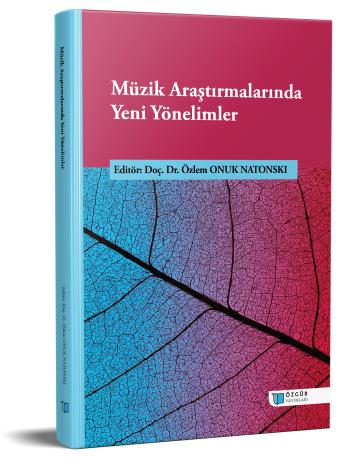
New Trends in Music Research
Synopsis
Throughout history, music has served not only as an aesthetic mode of expression but also as a vehicle for individual identity, collective memory, technical creativity, and cultural transformation. The chapters compiled in this volume reveal a clear shift in music research toward increasingly multilayered, interdisciplinary, and critically reflective frameworks. Ranging from historical analyses of traditional Turkish music forms to studies on self-construction through music, from feminist musicological perspectives to the role of artificial intelligence in contemporary musical expression, this collection offers original contributions to diverse dimensions of musical knowledge.
The studies demonstrate that contemporary issues in music are not solely technical or historical in nature, but are also deeply embedded in social, cultural, and philosophical contexts. From the individual’s relationship with sound to evolving instrumental techniques, from archival readings of early cultural periodicals to the reinterpretation of modal expression through contemporary means, these contributions affirm that music research is a dynamic, evolving field rather than a static one.
Each chapter, through its distinct methodological and theoretical approach, enriches our ways of thinking about music while also opening up new lines of inquiry for future scholarship. In this respect, the volume serves not only as a valuable academic resource but also as a potential guide for practitioners and researchers shaping the future direction of music studies.
It is our hope that this collection contributes meaningfully to research perspectives that are rooted in musical heritage while actively seeking new trajectories into the future.
Chapters
How to cite this book
License

This work is licensed under a Creative Commons Attribution-NonCommercial 4.0 International License.
Published
ISBN
DOI
Statistics
Categories
Copyright (c) 2025 Özlem Onuk Natonski; Fatih Tüysüz- Derya Kaçmaz- Duygu Ulusoy Yılmaz- Gamze Köprülü Yazıcı- Aziz Destegül- Hasan Mert