
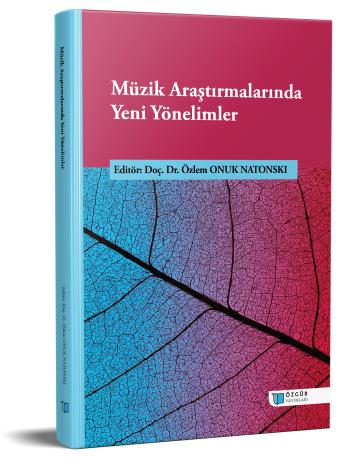
Analysis of Turkish Music Instrumental Music and Non-Religious Vocal Music Forms in Terms of Their Concise History
Chapter from the book:
Onuk Natonski,
Ö.
(ed.)
2025.
New Trends in Music Research.
Synopsis
This section examines the “instrumental music” (instrumental) and non-religious “lyrics music” (vocal) forms of Turkish music within a concise historical perspective, systematically examining the factors that shaped and shaped these forms. Turkish religious musical forms, considered within the branch of verbal music, are excluded from this study because they constitute a comprehensive and independent field of study. As with all other musical forms, the distinctive characteristics of works unique to “classical” Turkish music have led to a “form classification approach” that became particularly evident within the Ottoman musical tradition centered in Istanbul. Throughout this historical process, musical forms have increasingly diversified and are thus classified according to their compositional and non-compositional forms, lyrical content, compositional purposes, venues, performance styles, instruments used in performance, usuls, and even melody structures. In this context, based on all these “essential elements” that play a significant role in the formal definition of Turkish musical works, instrumental forms such as “Taksîm, Peşrev, Medhâl, Saz Semâî, Longa, Sirto, Oyun Havası, Mandıra, Çiftetelli, Zeybek, Aranağme” along with vocal forms such as “Kâr, Beste, Semâî, Gazel, Şarkı, Türkü, Köçekçe and Tavşanca, Gazel, Mehter Marches are examined in detail within the scope of this study, in terms of their emergence, development, and transformation throughout the historical process. In addition, this study aims not only to evaluate the “instrumental music” and non-religious “lyrics music” forms of Turkish music in terms of their development and changes throughout the historical process, but also to present all these formal structures to the benefit of researchers within a holistic framework in the context of “formal transformation” and “functional diversity” in terms of today’s music.
How to cite this book
License

This work is licensed under a Creative Commons Attribution-NonCommercial 4.0 International License.
Published
DOI
Categories
Copyright (c) 2025 Özlem Onuk Natonski; Fatih Tüysüz- Derya Kaçmaz- Duygu Ulusoy Yılmaz- Gamze Köprülü Yazıcı- Aziz Destegül- Hasan Mert