
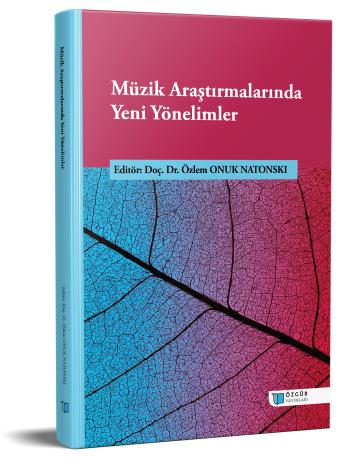
A Feminist Musicological Perspective on Position of Women in Music in the Early Republican Era
Chapter from the book:
Onuk Natonski,
Ö.
(ed.)
2025.
New Trends in Music Research.
Synopsis
This study examines the position of women in the musical life of the early Republican period through a feminist musicological perspective. The main reason of this study is the need to understand women’s emergence on stage not merely as evidence of modernization, but as part of a broader process that reshaped the nation’s sonic presence, affective landscape, and relationship with the body. Drawing on the frameworks of Joan Scott, Suraiya Faroqhi and Deniz Kandiyoti, Republican modernity is approached as a nation-building project structured through gender; and through the contributions of Susan McClary, Marcia Citron and Ruth Solie, the gendered nature of music history is brought into discussion. The analysis presented here does not claim to encompass the entirety of the field, but rather aims to offer a modest contribution toward drawing greater attention to it.
The conceptual framework adopted in this study can be observed through women’s engagement with music from the Ottoman Empire into the Republic. It is shown that the musical practices of women limited largely to the palace before Tanzimat expanded with changing educational opportunities and shifting aesthetic cultures during the Tanzimat and Meşrutiyet periods, and that this accumulated experience formed part of the cultural groundwork upon which the Republic built its policies. The women’s roles in performance, education, radio and musical life during the early Republican period through several pioneering figures was analyzed, and also this study highlighted that this visibility unfolded within a domain shaped by strict normative expectations. Music history has long been written from a male-centered perspective, leaving women’s contributions are ignored. However, any comprehensive assessment of music in the early Republican period becomes possible only when women’s effort is fully taken into account. Uncovering women’s historical presence requires sustained engagement with oral history, archival research, and studies of local musical practices, all of which play a crucial role in making their contributions visible.
How to cite this book
License

This work is licensed under a Creative Commons Attribution-NonCommercial 4.0 International License.
Published
DOI
Categories
Copyright (c) 2025 Özlem Onuk Natonski; Fatih Tüysüz- Derya Kaçmaz- Duygu Ulusoy Yılmaz- Gamze Köprülü Yazıcı- Aziz Destegül- Hasan Mert