
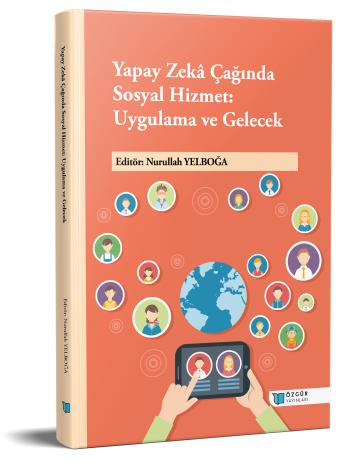
Social Work in the Age of Artificial Intelligence: Practice and Future
Synopsis
Developments in digitalization and artificial intelligence technologies are bringing about significant transformations in many areas of social life, including social policy and social work practices. The increasing prevalence of data-driven decision-making processes, the restructuring of service delivery models, and the emergence of new ethical debates necessitate a reconsideration of the role of the social work discipline in the age of artificial intelligence. In this context, the present volume titled Social Work in the Age of Artificial Intelligence: Practice and the Future aims to examine the current and potential impacts of artificial intelligence technologies in the field of social work from a multidimensional perspective.
The book consists of chapters that address the theoretical, ethical, educational, and practical dimensions of the social work discipline through a holistic approach. The opening chapter discusses the effects of artificial intelligence technologies on the welfare state within the context of social policy and explores possible future transformations. This is followed by a chapter that examines a social benefit-oriented artificial intelligence approach in social work, evaluating how technological developments can be utilized in line with the principles of social welfare and public benefit.
Another chapter focuses on artificial intelligence and digital competencies in social work education. The ongoing process of digital transformation is reshaping not only service delivery mechanisms but also the structure and content of social work education. In this context, it is becoming increasingly important for social work students to acquire new competencies such as data literacy, digital ethical awareness, the ability to understand AI-assisted decision-making processes, and the capacity to integrate technology with human-centered service provision.
Subsequent chapters address the ethical and human rights dimensions of artificial intelligence applications, discussing the risks and responsibilities that may arise from the integration of such technologies into social service systems. The book also examines field experiences and practical examples of AI applications in social work practice, while exploring the effects of digitalization on individual and family relationships through the concept of “digital loneliness.”
In the later sections of the book, different dimensions of social transformation are explored. In particular, the role of artificial intelligence applications and robotic technologies in elderly care is discussed, highlighting emerging approaches in care services. The potential of smart care systems, robot-assisted living applications, and digital health technologies to improve the quality of life of older adults is examined, while the opportunities and ethical responsibilities these technologies present from a social work perspective are also critically evaluated. Furthermore, the transformative effects of artificial intelligence technologies on family structures and intra-family relationships are addressed. The position of the family in an increasingly digital world is examined in relation to individuals’ search for meaning, spirituality, and emerging practices of digital guidance and counseling.
Adopting an interdisciplinary perspective, this volume serves as an important reference for social work scholars, practitioners, social policy researchers, and graduate students who seek to understand the theoretical foundations, educational implications, and practical applications of social work in the age of artificial intelligence. By examining the relationship between technological developments and the human-centered values of social work, the book aims to open new avenues of thought for the future of social work practice and education.
Chapters
How to cite this book
License

This work is licensed under a Creative Commons Attribution-NonCommercial 4.0 International License.
Published
ISBN
DOI
Statistics
Categories
Copyright (c) 2026 Nurullah Yelboğa; Safter Bozarslan- Hatice Hale Yurttabir- Merve Karaman- Bekir Altıok- Kamil Ateş- İrfan Yıldırım- Muhammed Yusuf Bulut- Selman Bölükbaşı- Kadri Kınık