
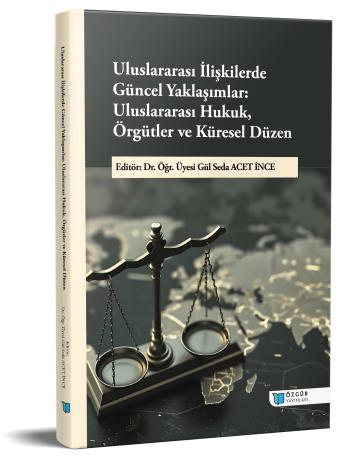
Current Approaches in International Relations: International Law, Organizations, and the Global Order
Synopsis
The international system has been undergoing a significant transformation in recent years, influenced by developments such as shifts in global power balances, the rise of new actors, and the reshaping of regional conflicts and crises. This process, while reopening the discussion on the structural characteristics of international politics, necessitates a reassessment of current theoretical approaches and regional analyses in the international relations literature. Prepared within this framework, the study entitled "Contemporary Approaches in International Relations: International Law, Organizations and the Global Order" aims to examine these transformations from different theoretical and regional perspectives.
The studies included in the book cover a wide range of thematic areas, from international security and energy geopolitics to great power competition, regional organization initiatives, the economic and strategic dimensions of international law, and the reflections of social movements in international politics. Within the framework of the regional security complex theory, current dimensions of security discussions are examined, and China's global power projection and the question of whether the international system is evolving towards multipolarity are also evaluated. In addition, within the context of hegemonic order debates, topics such as the Trump doctrine, the effects of energy geopolitics on the international system, state recognition politics in the Horn of Africa, the changing global context of the Jerusalem issue, and new regional organizational initiatives in Latin America have been examined in light of different academic approaches. The book also examines the current dynamics of the Cyprus issue within the framework of conflict resolution theories, and includes a study focusing on women's movements in Turkey, which serve as an example of social support for the Palestinian struggle.
Bringing together diverse academic perspectives and current topics of debate, this study aims to contribute to theoretical and empirical research in the field of international relations. Prepared with contributions from academics who are experts in their fields, this work serves as an important reference source for researchers and graduate students seeking to understand the transformations taking place in international politics.
I would like to take this opportunity to thank all the authors who contributed to this work for their valuable efforts and meticulous work. I hope that this book, which brings together different perspectives, will contribute to the current debates in the international relations literature.
Chapters
How to cite this book
License

This work is licensed under a Creative Commons Attribution-NonCommercial 4.0 International License.
Published
ISBN
DOI
Statistics
Categories
Copyright (c) 2026 Gül Seda Acet İnce; Ahmet Üçağaç- Figen Aydın- Ayşe Gökçe Arslan- Burcu Gökatalay- Meliha Elif Güven- Hande Sapmaz- Zuhal Çalık Topuz- Canan Kışlalıoğlu- Sıddık Arslan- Burak Kurtcebe