
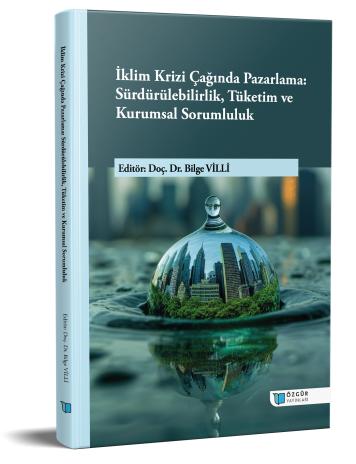
Marketing in the Era of the Climate Crisis: Sustainability, Consumption, and Corporate Responsibility
Synopsis
Beyond being one of the most important global problems of our time, the climate crisis is a multifaceted phenomenon transforming all aspects of life, from economic systems and social structures to production processes and consumption habits. Environmental problems, deepened by industrialization, urbanization, overuse of natural resources, and unsustainable production and consumption patterns, not only threaten ecological balances but also bring about a structural transformation that reshapes the operations of businesses, public policies, and individual behaviors. In this context, the climate crisis has ceased to be a subject solely within the purview of environmental sciences or policymakers; it has become a fundamental research area for social sciences, particularly business, economics, marketing, and management.
The marketing discipline, in particular, is undergoing a significant paradigm shift in line with the new expectations arising from the climate crisis. The growth and consumption-oriented approaches that formed the basis of traditional marketing are being replaced by sustainable value creation, responsible consumption, ethical marketing, corporate social responsibility, and stakeholder-centric management. Today, businesses are evaluated not only on their economic performance but also on their environmental impact, social responsibility, and sustainability practices. Similarly, consumers are increasingly considering environmental sensitivity, ethical production, and sustainable brand practices in their purchasing decisions.
This work, titled “Marketing in the Era of Climate Crisis: Sustainability, Consumption, and Corporate Responsibility,” aims to address the marketing discipline in the context of the climate crisis, using current theoretical approaches and application areas. The chapters offer a broad perspective, ranging from the historical development of the concept of sustainability to its impact on marketing understanding; from a bibliometric analysis of the sustainable consumption literature to the relationship between consumer culture and the climate crisis. Furthermore, the book discusses in detail the effects of environmental concerns on consumer behavior, the relationship between eco-anxiety and sustainable consumption, the role of consumer activism in sustainability governance, the corporate responsibilities of brands in the face of the climate crisis, and sustainability strategies. One of the book's notable aspects is its inclusion of studies that contribute innovative methodological approaches to sustainability research. In particular, the examination of greenwashing perceptions from a neuromarketing perspective, using electroencephalography (EEG) and eye-tracking techniques together, highlights the importance of interdisciplinary research aimed at understanding the unconscious processes of consumer behavior.
Mitigating the effects of the climate crisis and achieving sustainable development goals is not possible solely through technological innovations or legal regulations. This process requires businesses to adopt responsible management practices, consumers to develop informed choices, and marketing strategies to be restructured in line with sustainability principles. Marketing, as one of the most important actors in this transformation, plays a critical role in creating sustainable value, spreading a culture of responsible consumption, and increasing environmental awareness in society.
I would like to express my gratitude to all the chapter authors who contributed their knowledge and experience to the preparation of this work, and to the publishing house for their support during the publication process. My most important hope is that this book, which brings together researchers from different disciplines on a common scientific ground, will contribute to research in the fields of climate crisis and marketing, encourage interdisciplinary collaborations, and offer a scientific perspective on policies and practices developed for a sustainable future. Believing that scientific knowledge is one of the strongest foundations for developing solutions to the climate crisis, I hope this work will be beneficial to the academic world, practitioners, and all readers interested in the subject.
Chapters
How to cite this book
License

This work is licensed under a Creative Commons Attribution-NonCommercial 4.0 International License.
Published
ISBN
DOI
Statistics
Categories
Copyright (c) 2026 Bilge Villi; Melike Gül- Kudret Gül- Gulnara Karadeniz- Mehmet Ozan Karahan- Selman Temiz- Fatih Şahin- Reyhan Bahar- A. Selçuk Köylüoğlu