
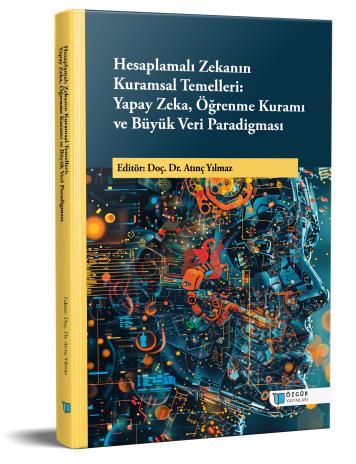
Theoretical Foundations of Computational Intelligence: Artificial Intelligence, Learning Theory, and the Big Data Paradigm
Synopsis
Artificial intelligence has evolved from being a specialized subfield of computer science into a transformative paradigm that affects nearly every aspect of modern society, including science, engineering, healthcare, education, industry, and public administration. Advances in computational power, the unprecedented growth of data, and the maturation of learning algorithms have accelerated the integration of intelligent systems into everyday life.
Despite these developments, the theoretical foundations underlying contemporary artificial intelligence systems are often overlooked in favor of practical applications. Modern approaches such as machine learning, deep learning, and large-scale data analytics are deeply rooted in mathematical modeling, computational theory, statistical learning, and optimization principles. Therefore, a comprehensive understanding of artificial intelligence requires an examination of both its conceptual and theoretical dimensions. Moreover, the emergence of the big data paradigm has redefined the scale and complexity of intelligent systems, making data availability and large-scale analytics central components of modern artificial intelligence.
This book has been prepared as an interdisciplinary reference that examines the theoretical foundations of artificial intelligence, learning theory, and the big data paradigm together with their contemporary application domains. While presenting the mathematical and computational principles underlying intelligent learning systems, the book also explores emerging research areas such as healthcare analytics, cybersecurity, social media intelligence, multimodal data processing, and learning under data-scarce conditions. In this context, artificial intelligence is treated not merely as an algorithmic discipline, but as a comprehensive scientific paradigm that extracts knowledge from large-scale data and drives transformative change across diverse domains of science, engineering, and society.
Designed for undergraduate and graduate students, researchers, academics, and industry professionals, this work seeks to strengthen the reader's theoretical understanding of artificial intelligence and provide a solid foundation for interpreting current developments and future technological transformations. The book aims to serve as a valuable reference for researchers, students, and practitioners working at the intersection of artificial intelligence, learning theory, and big data, while inspiring future interdisciplinary research in these rapidly evolving fields and contributing to a deeper understanding of one of the most influential technological revolutions of our time.
Chapters
How to cite this book
License

This work is licensed under a Creative Commons Attribution-NonCommercial 4.0 International License.
Published
ISBN
DOI
Statistics
Categories
Copyright (c) 2026 Atınç Yılmaz; Sara Naghib Zadeh- Zühre Aydın- Hatice Nur Gök- Cansu Arslan- Uygar Aydın- İnci Zaim Gökbay- Mehmet Dinçer Erbaş- Kenan Peker- Gökhan Önder Ergüven- Tevfik Erdal Baylay- Atınç Yılmaz