
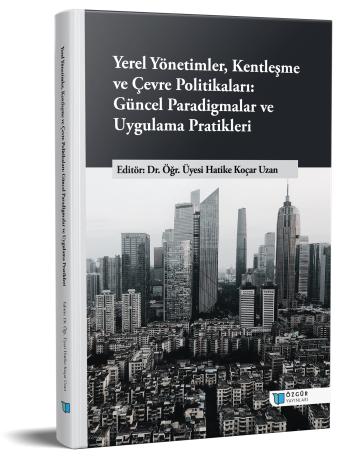
Local Governments, Urbanization, and Environmental Policies: Contemporary Paradigms and Implementation Practices
Synopsis
Local governments today stand as key actors in democratic governance, social participation, and sustainable development. Confronted with changing socioeconomic dynamics and environmental challenges, local administrations are no longer viewed merely as administrative entities but as guarantors of social justice, environmental responsibility, and economic resilience. In this context, the book “Local Governments, Urbanization and Environmental Policies: Current Paradigms and Practical Applications” aims to analyze how local governments are transforming within contemporary governance frameworks and to reveal how this transformation influences urbanization and environmental policy. The chapters gathered in this volume examine the structural, administrative, and social dimensions of local governments in Turkey from multiple perspectives, aiming to contribute both to academic literature and to local-level policy design processes.
In the first chapter, Necati Uysal and Şükrü Mert Karcı present a comprehensive study titled “The Historical Development and Transformation of Local Governments in Turkey.” The authors trace the evolution of local governance from the Ottoman Empire to the Republic and the present-day metropolitan model. Their analysis situates this transformation within the context of democratization, fiscal autonomy, and governance capacity, highlighting the historical foundations that continue to shape Turkey’s local government system. This chapter provides a strong theoretical and historical basis for understanding local governance transformations.
The second chapter, authored by Öznur Gökmen, titled “An Examination of Rural Settlements with Populations Over 5,000 Yet Lacking Municipal Organization,” explores the legal and administrative boundaries of Turkey’s local governance system. Gökmen argues that beyond population thresholds, economic, political, and sociocultural dynamics also play a decisive role in the establishment of municipal institutions. The study offers an insightful discussion on spatial justice, representation, and administrative equity, adding an original and timely perspective to local governance debates.
In the third chapter, Gamze Kara Çetinkaya investigates “Smart City Policies of Metropolitan Municipalities: The Cases of Istanbul, İzmir and Ankara.” Focusing on the digital transformation of urban management, Çetinkaya conceptualizes smart cities not only as technological innovations but as governance models grounded in participatory democracy, data-driven decision-making, environmental efficiency, and sustainable development. Through a comparative analysis of the three largest cities, the study reveals both the strengths and developmental challenges of Turkey’s smart city strategies.
The fourth chapter by Gamze Çürüksulu Usta, titled “Child-Friendly Local Governments and Sustainability in the Light of National and International Standards,” emphasizes the social dimension of sustainability in local governance. Drawing on a child rights perspective, the author examines how child-friendly local policies align with global sustainability goals. By bridging urban planning, social policy, and participatory governance, this chapter powerfully underscores the responsibility of local administrations to deliver inclusive and equitable services.
In the fifth and final chapter, Dilan Uslu and Murat Doğan present “Urban Recycling Behaviors in Turkey: A Study Based on the Theory of Planned Behavior – The Case of Manisa.” This research explores the relationship between local environmental policies and individual behavioral patterns through the lens of social psychology. Grounded in the Theory of Planned Behavior, the study analyzes attitudes, subjective norms, and perceived behavioral control influencing recycling behaviors in Manisa. The findings underline the critical role of behavioral factors in the success of local environmental management strategies.
This book is designed to serve as a comprehensive reference for scholars, practitioners, and policymakers working in the fields of local governance, urbanization, and environmental policy. Enriched by multidisciplinary perspectives, it highlights the pioneering role of local governments in promoting sustainable, inclusive, and innovative models of urban governance.
Chapters
How to cite this book
License

This work is licensed under a Creative Commons Attribution-NonCommercial 4.0 International License.
Published
ISBN
DOI
Statistics
Categories
Copyright (c) 2025 Hatike Koçar Uzan; Necati Uysal- Şükrü Mert Karcı- Özgür Gökmen- Gamze Kara Çetinkaya- Gamze Çürüksulu Usta- Dilan Ulus- Murat Doğan