
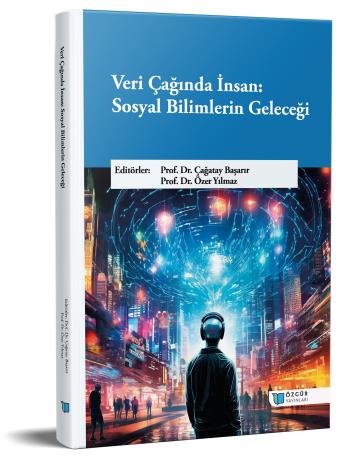
Human in the Data Age: The Future of Social Sciences
Synopsis
Digitalization is advancing at an unprecedented pace in human history. As a result, human behavior, forms of social organization, and economic processes are undergoing profound transformations. In the age of data, every aspect of life has become measurable, traceable, and modelable. The relationships between individuals, institutions, and society require a new epistemological framework. This book, entitled Human in the Age of Data: The Future of the Social Sciences, aims to examine the impact of technology from a human-centered perspective and discuss how the social sciences can respond to this major transformation.
The first section covers the technical foundations and contemporary applications of artificial intelligence and computer vision. It provides background on the transformations occurring in digital health, security, transportation, and space research. The second section offers a comprehensive analysis of how large language models are used in job interviews. It examines the efficiency gains these models bring to candidate evaluation processes, as well as the ethical debates they generate.
The third section focuses on the invisible side of digitalization, explaining the theoretical relationship between technostress and burnout to make the psychological costs of digital working life visible. The fourth and fifth sections examine the dual transformation created by digitalization in tourism. On the one hand is the reshaping of tourist experiences through digitally mediated experiential marketing. On the other hand is the transformation of strategic decision-making processes in the tourism sector through AI-based data analytics.
The sixth section discusses the unique opportunities digital twin technology offers in planning sustainable tourism, drawing attention to the environmental, cultural, and economic dimensions of data-driven governance. The seventh section emphasizes that demand forecasting is shaped by both quantitative models and human judgment, highlighting the hybrid nature of decision-making processes in the data age.
The eighth section centers on the concept of the "green gap" in the context of the climate crisis. It examines the mismatch between increasing data intensity and policy outcomes related to social behavior through the lens of global governance debates. The ninth section demonstrates that ERP system success depends less on technical architecture than on integrating human, technological, and process dimensions. It argues that this process must be evaluated across psychological, organizational, and technical axes.
We believe that the tenth section will further deepen this holistic discussion by reinforcing a human-centered perspective in the data age. This book provides an interdisciplinary foundation for rethinking the role of the social sciences in the data age. Approaching technology as an ecosystem that transforms human behavior rather than merely as a tool, these contributions aim to enrich academic literature and practical applications.
We thank all the contributing authors and hope this collective work inspires new academic debates and future research.
Prof. Dr. Çağatay BAŞARIR
Prof. Dr. Özer YILMAZ
Chapters
How to cite this book
License

This work is licensed under a Creative Commons Attribution-NonCommercial 4.0 International License.
Published
ISBN
DOI
Statistics
Categories
Copyright (c) 2025 Çağatay Başarır- Özer Yılmaz; Nur Kuban Torun- Merve Önalan- Ömer Faruk Seymen- Volkan Akgül- Müjde Aksoy- Özer Yılmaz- Burçin Boz- Mehtap Türkan- Özgür Yılmaz- İlknur Tanrıverdi- Altuğ Günar- Çağatay Başarır- Cemalettin Hatipoğlu- Onur Özaydın