
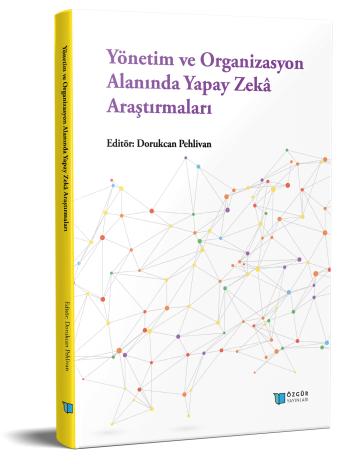
Artificial Intelligence Research in Management and Organization
Synopsis
From Decision Support Systems Toward Decision-Making Systems…
Technology, a recurring element at crucial turning points in humanity's historical journey, is a factor that ends eras or pawes the way for new ages through the benefits and superiorities it provides to societies, ranging from the processing of raw materials to the weapons used. While the pace of technological development and its widespread use has progressed slowly, it is evident that a leap was experienced especially during the periods of world wars. From the subsequent period to the present day, businesses have taken on this role of development and expansion.
The impact of technology on businesses has been significant in every period. However, in our current era, this impact is causing both a quantitative and qualitative transformation thanks to artificial intelligence, which holds a critical place on a global scale. The concept of artificial intelligence, to which our language has quickly become accustomed in daily use, is essentially not a new term in the management and organization literature. Many approaches, from expert systems to fuzzy logic, and from data mining to machine learning, have been addressed under this heading for many years. Although artificial intelligence is an established concept used in the literature for a long time, what is frequently mentioned in everyday language is actually generative artificial intelligence. These concepts are critical elements that have fundamentally affected, improved, and transformed the world of business and management in the last few years.
This book focuses on a question that stands right at the center of these worlds: "How is artificial intelligence transforming management and organizations?". Along with this, it seeks an answer to the question of whether this transformation is evolving from a human-centered support mechanism in decision-making processes into a decision-making system that operates through a human-artificial intelligence partnership.
Today, artificial intelligence is no longer just a tool that processes data, but an organizational actor candidate for understanding behaviors, predicting decisions, optimizing processes, and sometimes making decisions directly. This situation radically redefines the distribution of roles within the organization, leadership practices, employee experience, and the functioning of human resources management. Therefore, the widespread use of generative artificial intelligence is not only a technological development but also a comprehensive transformation that touches the strategic, behavioral, and managerial dimensions of organizations.
In this context, each chapter of the book addresses the multi-layered impact of artificial intelligence in organizations with a systematic perspective: The first chapter examines the employee–artificial intelligence interaction in terms of organizational behavior, covering a wide range from employees' attitudes to psychological adaptation, and from perceived threats and opportunities to performance dynamics. The second chapter discusses the relationship between artificial intelligence and leadership concepts; it reveals the current situation by examining the trends in artificial intelligence and leadership literature and offers suggestions for future studies. The third chapter focuses on the role of artificial intelligence in human resources management, investigating which HRM functions and practices stand out prominently in academic research. When these three chapters are considered together, they reveal that organizations are in a state of great change and transformation along with artificial intelligence. Understanding this transformation in the field of management and organization will be possible not only by knowing the technology but also by re-establishing the delicate balance between people, processes, and leadership.
This work serves as a roadmap for those who view artificial intelligence not as an isolated technology, but as a fundamental element that will revitalize human-artificial intelligence cooperation. While providing a conceptually sound and up-to-date perspective to academics, practitioners, and organizational professionals working with artificial intelligence, managers and employees will cease to be passive observers of change and become active actors of the transformation.
Chapters
How to cite this book
License

This work is licensed under a Creative Commons Attribution-NonCommercial 4.0 International License.
Published
ISBN
DOI
Statistics
Categories
Copyright (c) 2025 Dorukcan Pehlivan; Mehmet Ali Taş- Seher Yastıoğlu- Tuğba Erhan- Dorukcan Pehlivan