
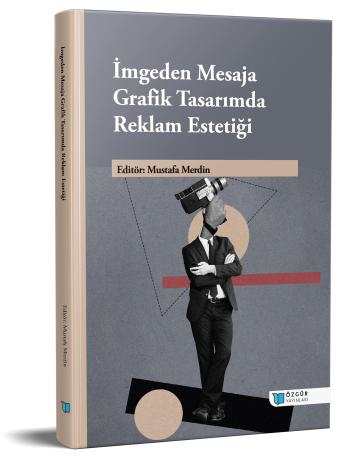
From Image to Message: Advertising Aesthetics in Graphic Design
Synopsis
n today’s rapidly transforming visual culture, advertising has moved beyond being merely a tool for promoting products or services; it has become an aesthetic field in which social values, cultural codes, and ideological discourses are intensively produced. **“From Image to Message: Advertising Aesthetics in Graphic Design”** focuses on this transformation and approaches advertising as a multilayered communication practice shaped by image, typography, narrative, and myth-making.
The first chapter examines the relationship between contemporary advertising discourses and social sensitivity through the concept of **woke marketing**, critically discussing how brands translate notions such as social justice, inclusivity, and ethical awareness into marketing strategies. This chapter emphasizes that advertising is not only an economic instrument but also a cultural and political space of representation.
The second chapter explores **fairy tales** as one of humanity’s shared narrative sources, addressing their archetypal structures and analyzing their reflections in art and visual design. Fairy-tale language is evaluated as a key reference that nourishes the narrative power of advertising aesthetics through unconscious imagery and collective symbols.
The third chapter reveals that **typography** is not merely a formal design element but a semiotic system that produces cultural meaning. By analyzing typefaces within their historical, social, and ideological contexts through a semiotic framework, this chapter examines how typography transforms and deepens messages. In doing so, it highlights the decisive role of written form in visual identity.
In the fourth chapter, **myth-making in modern advertising** and illustrative sign systems are examined, focusing on how advertising visuals construct contemporary myths. Illustration is approached not only as an aesthetic preference but as a narrative language rich in meaning, and the function of visual metaphors in advertising aesthetics is discussed in detail.
The final chapter addresses **micro-typography and readability** within the context of the gaming world, where digitalization has transformed reading and perception practices. Digital screens, interactive interfaces, and game-based design practices are evaluated through contemporary examples that reveal the new aesthetic and functional roles of typography.
This book approaches graphic design not merely as a field of visual production but as a **meaning-making practice** deeply intertwined with culture, society, and narrative. By framing advertising aesthetics as a process extending from image to message, this work aims to serve as a comprehensive reference for academics, designers, advertisers, and all researchers working in the field of visual communication.
Chapters
How to cite this book
License

This work is licensed under a Creative Commons Attribution-NonCommercial 4.0 International License.
Published
ISBN
DOI
Statistics
Categories
Copyright (c) 2025 Mustafa Merdin; Burçe Akcan- Yasemin Tanrıverdi- Burhan Şohoğlu- Ozan Küçükusta- M. Furkan Terzi- Mustafa Merdin