
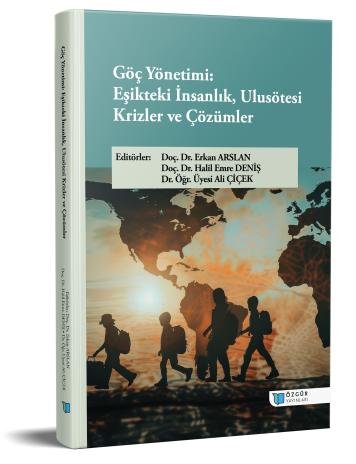
Migration Management: Humanity at the Threshold, Transnational Crises, and Solutions
Synopsis
At the dawn of the 21st century, migration is no longer merely a population movement; it is a multi-layered reality that simultaneously tests political systems, social structures, and economic balances. Throughout history, migration has played a decisive role in the rise and fall of empires, the growth of cities, and the reformation of classes. Today, the same continuity confronts us, albeit at a higher speed, on a broader scale, and with deeper fragility. As borders sharpen, routes multiply; as security discourses grow, human needs become more visible. Therefore, “migration management” is no longer merely an administrative technique but has become a direct subject of civilizational imagination. This book stems from the idea that this vision must be reestablished on both scientific and political planes.
The fundamental characteristic distinguishing modern-day migrations is the intertwining of the causes of mobility: war, poverty, the climate crisis, the erosion of state capacity, and inequality. This combination takes migration beyond a simple “push-pull” equation; it places it at the heart of globalization. Transnational networks, diaspora relations, and digital communication reshape the migrant experience, while the perceptions and political preferences of host societies are also directly affected by this transformation. The rise of populist ideologies draws debates on migration not only into the sociological but also sharply into the political arena. In short, the historically active role of migratory movements will continue in this century; however, it will now reproduce itself on a more complex plane.
Migration management is now a litmus test for the capacity of states, both in terms of normative principles and institutional practices. Areas such as health, education, social policy, children's rights, and human security must be redesigned in light of the effects of migration. As the role of international institutions and regional cooperation mechanisms expands, political will and bureaucratic coordination at the national level become even more critical. However, every “regulation” also produces its opposite: exclusionary language, mistrust, and social tension. Precisely for this reason, the concept of governance means not only “control” but also “harmony,” “rights,” “justice,” and “sustainability.” The issue of migration grows when confined to a narrow security perspective; it becomes manageable when addressed with a broad social mindset.
At this point, the responsibility of academia is not only to describe the issue but also to conceptualize, measure, compare, and make a genuine contribution to policy design. We must think more about migration management, devote more effort to it, and establish more interdisciplinary cooperation. For if academia remains silent, slogans fill the field; if data is withdrawn, prejudice advances. When migration is not managed with knowledge, it begins to be managed with fear; and when managed with fear, the issue ceases to be a “crisis” and becomes a permanent “wound.” To put it in a nutshell: Migration is not a river that flows by itself; if its bed is not properly opened, it overflows, and if it overflows, it brings destruction. And yes, sometimes “humanity is on the threshold”; what raises or lowers the threshold is reason, science, justice.
This study aims to establish a platform for discussion by addressing the multidimensional nature of migration across different scales and thematic areas. We invite you to rethink the manageability of migration within a holistic framework that spans from theoretical frameworks to the functioning of international institutions, from regional dynamics to political discourses in the Turkish context, and from education to health, social policy, and children's rights. Furthermore, by focusing on topics that will shape the future, such as climate migration, we emphasize the effort to read “today's problems” alongside tomorrow's scenarios.
Instead of a final word, it would be appropriate to reiterate the emphasis in the title of this book: Humanity at the threshold, transnational crises and solutions... The threshold is a choice; it either welcomes or excludes, either calls for collective reason or erodes collective conscience. We believe that at this threshold, it is possible to adopt an approach that puts humanity at the center; one that is realistic rather than romantic, analytical rather than emotional, and institutional rather than reactive. Managing migration reveals not only a country's capacity but also its character; public order is strengthened where compassion meets reason. This work is an invitation to bring academic knowledge and policy thinking to the same table in a world where migration will continue to be decisive in the future. If accepted, the paths to making a global problem manageable will multiply; if not, migration will continue to test us all as an unmanageable global problem.
Chapters
How to cite this book
License

This work is licensed under a Creative Commons Attribution-NonCommercial 4.0 International License.
Published
ISBN
DOI
Statistics
Categories
Copyright (c) 2025 Erkan Arslan- Halil Emre Deniş- Ali Çiçek; Erkan Arslan- Halil Emre Deniş- Fatih Demircioğlu- Ali Çiçek- Aslıhan Çiçek- Abdullah Turan- Abdulkadir Yüksel- Ömer Nabi Baykal- Didem Kayahan Yüksel - Pervin Bozkurt- Ömer Yılmaz- Fatime Gül Oktay Atsatan- Mustafa Uzan- Tolgay Ercan