
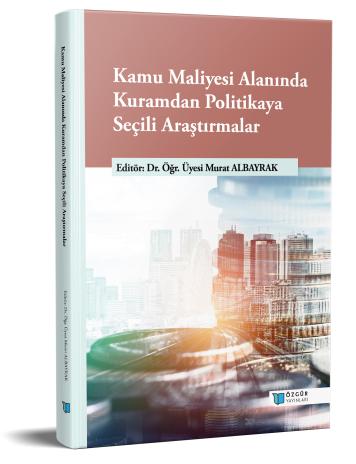
Selected Studies from Theory to Policy in Public Finance
Synopsis
The volume titled Selected Studies in Public Finance from Theory to Policy brings together distinguished academic studies that examine the relationship between theoretical debates in the discipline of public finance and contemporary fiscal policy practices from a multidimensional perspective. In an era marked by rapid global economic, technological, and institutional transformations, it has become increasingly important that scholarly knowledge produced in the field of public finance not remain confined to the theoretical realm but also inform policy design and implementation. This book has been prepared in response to this necessity.
The chapters included in the volume address core and complementary subfields of public finance—such as public expenditures, taxation, environmental fiscal instruments, and public administration—and aim to contribute to the literature in a comprehensive manner by jointly presenting normative and positive analyses. By combining theoretical frameworks with empirical findings, the book provides a basis for translating academic debates into concrete policy recommendations.
In the first chapter, Dr. Cemil Altun and Prof. Dr. Osman Pehlivan, in their study titled “R&D Support in Türkiye: An Overall Evaluation within the Framework of Türkiye’s 2053 Vision” examine R&D support mechanisms implemented in Türkiye within the framework of contemporary growth theories and the national innovation system approach, assessing the extent to which the current support structure aligns with the high value-added production and innovation objectives envisioned in the 2053 vision from a comparative perspective.
In the second chapter, Res. Asst. Abdülhamid Özgün Birkalan and Prof. Dr. Recep Tekeli, in their study titled “Determining Türkiye’s Place Among OECD Countries in Terms of Tax Wedge Using K-Means Method and Sigma Convergence” analyze Türkiye’s position among OECD countries with respect to the tax wedge using the K-means clustering method and the concept of sigma convergence. The findings indicate that Türkiye’s tax wedge structure closely resembles that of European Union countries and exhibits periods of convergence with and divergence from the OECD average.
In the third chapter, Dr. Muhammet Aktug and Dr. Hüseyin Unal, in their study titled “An Empirical Evaluation of the Impact of Environmental Taxes on Environmental Degradation” investigate the effects of environmental taxes on the ecological footprint in EU countries over the period 1995–2023 by employing clustering analysis and the CS-ARDL model. The results reveal that the environmental impacts of environmental taxes vary across country groups, underscoring the need for country-specific and well-designed policy frameworks to reduce environmental degradation.
In the fourth chapter, Dr. Erkan Kılıçer, in his study titled “A New Tool for Participation in Public Administration: An Assessment of E-Participatory Budgeting” examines e-participatory budgeting within the context of e-government, e-governance, and e-democracy, evaluating its role in enhancing transparency and efficiency in the management of public resources. Drawing on practical applications and the EMPATIA project, the study highlights both the opportunities offered by e-participatory budgeting and the conditions required for its effective implementation.
In the fifth chapter, Dr. Imren Peker Kılıçer, in her study titled “Assessment of Other Income and Earnings in the Context of Tax Justice,” analyzes other income and earnings defined under the Income Tax Law within the framework of horizontal and vertical equity, examining deviations from the principle of tax justice in current practices and offering policy recommendations.
In the sixth chapter, Dr. Esra Hanbay Kahriman, in her study titled “The Justification of Taxation: Overview of the Benefit and Ability-to-Pay Principles,” addresses the normative foundations of taxation from a historical perspective, evaluating the strengths and practical limitations of both the benefit principle and the ability-to-pay principle in an objective manner.
Selected Studies in Public Finance from Theory to Policy is intended to serve as an important reference source not only for academics and graduate students working in the field of public finance, but also for policymakers involved in the design and implementation of fiscal policies. The studies included in the volume aim to make lasting contributions to the public finance literature while also providing a foundation for future academic and policy-oriented research.
Chapters
How to cite this book
License

This work is licensed under a Creative Commons Attribution-NonCommercial 4.0 International License.
Published
ISBN
DOI
Statistics
Categories
Copyright (c) 2025 Murat Albayrak; Cemil Altun- Osman Pehlivan- Abdülhamid Özgün Birkalan- Recep Tekeli- Muhammet Aktuğ- Hüseyin Ünal- Erkan Kılıçer- İmren Peker Kılıçer- Esra Hanbay Kahriman