
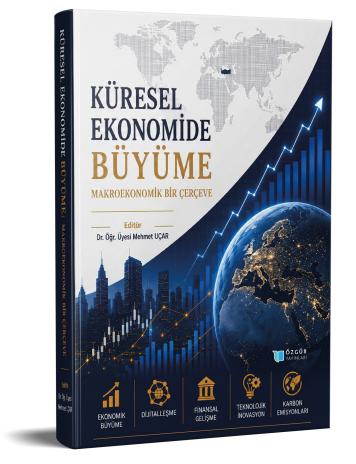
Growth in the Global Economy: A Macroeconomic Framework
Synopsis
In today’s world, where globalization, digitalization, technological transformation, energy policies, and geopolitical developments are reshaping the global economy, the concept of economic growth has evolved beyond a phenomenon that can be explained solely through increases in production. It has become a multidimensional and interdisciplinary field of research. In this context, this book, Growth in the Global Economy: A Macroeconomic Framework, has been prepared by bringing together academic studies that examine the dynamics of economic growth from both theoretical and empirical perspectives.
The chapters included in this volume have been prepared by distinguished researchers in their respective fields and address economic growth through contemporary and strategic variables such as digitalization, financial development, research and development expenditures, technological innovation, foreign trade, foreign direct investment, renewable energy, economic freedom, capital accumulation, inflation, and geopolitical risk. In this respect, the book aims not only to contribute to theoretical discussions but also to provide insights for policy-making processes and applied literature.
The chapter authored by Assist. Prof. Dr. Mehmet Uçar analyzes the effects of digitalization indicators, trade openness, and employment on economic growth in internet-leading countries. The study conducted by Assist. Prof. Dr. Mücahit Ülger examines the causal relationships between economic growth, R&D expenditures, and technological innovation in Türkiye. In another chapter, Assist. Prof. Dr. Mert Anıl Atamer investigates the relationships between economic growth, foreign direct investment, exports, and inflation in the Turkish economy.
Dr. Ayşe Eryer’s study evaluates the determinants of renewable energy consumption within the framework of environmental technological innovation and carbon emissions in the case of the G7 countries and Türkiye. Assoc. Prof. Dr. Gülferah Ertürkmen analyzes the relationship between economic freedom and economic growth in Türkiye and the Turkic Republics through panel causality analysis. The chapter prepared by Dr. Melek Kıdemli examines the relationships among digital infrastructure, financial development, and economic growth in Türkiye using the Fourier Toda–Yamamoto approach.
While the study by Lecturer Dr. Lokman Salih Erdem discusses the relationship between inflation and economic growth from the perspective of sustainable growth, the chapter by Assist. Prof. Dr. Kamuran Yıldız evaluates the effects of capital accumulation and digitalization on economic growth in Türkiye within the ARDL framework. Furthermore, Dr. Hüseyin Saltan analyzes the effects of geopolitical risks on Türkiye’s economic growth from both regional and global perspectives.
The fact that the studies in this book are presented in both Turkish and English enables the work to address national and international academic audiences. In this regard, the volume is consistent with the principles of quality, scientific visibility, and internationalization in higher education publishing.
The idea that economic growth is not merely a quantitative increase, but also a multidimensional process directly associated with sustainable development, technological transformation, environmental quality, financial stability, and social welfare constitutes one of the main motivations of this book. Therefore, the studies included in this volume are intended not only to contribute to the academic literature but also to serve as a useful resource for policymakers, researchers, and students.
I would like to express my sincere gratitude to all contributing authors for their valuable efforts and contributions to this work, and I hope that this book will make a meaningful contribution to the scientific literature.
Assist. Prof. Dr. Mehmet Uçar
Chapters
How to cite this book
License

This work is licensed under a Creative Commons Attribution-NonCommercial 4.0 International License.
Published
ISBN
DOI
Statistics
Categories
Copyright (c) 2026 Mehmet Uçar; Mehmet Uçar- Mücahit Ülger- Mert Anıl Atamer- Ayşe Eryer- Gülferah Ertürkmen- Melek Kıdemli- Lokman Salih Erdem- Kamuran Yıldız- Hüseyin Saltan