
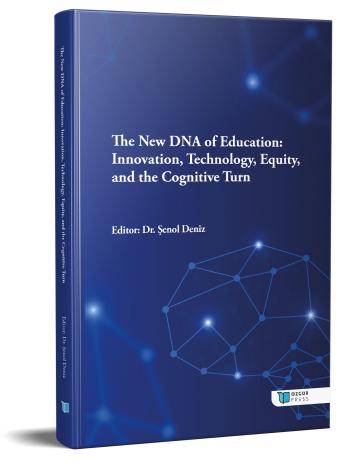
The New DNA of Education: Innovation, Technology, Equity, and the Cognitive Turn
İndir
Özet
Education has entered a phase of structural mutation rather than gradual reform. The conceptual metaphors that once dominated educational thought, transmission, standardization, and control, are increasingly inadequate for capturing the lived realities of contemporary learning ecosystems shaped by artificial intelligence, digital surveillance, ethical ambiguity, and widening social inequities. The New DNA of Education: Innovation, Technology, Equity, and the Cognitive Turn is conceived precisely at this critical historical moment. As editor of this volume, I approach this book not as a collection of independent chapters, but as a coherent intellectual architecture that examines how education is being re-coded at its most fundamental levels: cognitive, technological, ethical, and organizational.
The chapters assembled in this volume converge on a shared concern: how educational systems can remain secure, humane, intellectually rigorous, and equitable amid rapid AI-driven transformation. Rather than reproducing celebratory narratives of innovation, the contributions offer analytically grounded, practice-oriented, and ethically reflective perspectives. Collectively, they argue that the future of education depends not merely on technological adoption, but on epistemic responsibility, pedagogical integrity, leadership capacity, and moral imagination.
The chapter by Canan Battal and Şemseddin Gündüz, Evaluation of Authentication Schemes in Online Exams within the Framework of Information Security: CIA Triad, addresses one of the most urgent yet often under-theorized challenges of digital education: trust. As assessment increasingly shifts into online and hybrid environments, issues of identity verification, data protection, and system integrity become central to educational legitimacy. Grounded in the CIA Triad, confidentiality, integrity, and availability, this chapter provides a systematic evaluation of authentication mechanisms used in online examinations. Importantly, information security is not treated as a purely technical concern; rather, it is situated within broader educational ethics related to fairness, privacy, and institutional accountability. The chapter underscores that without secure and reliable assessment infrastructures; the promise of digital equity remains fundamentally fragile.
Complementing this structural focus, the chapter by Gizem Şahin, Examples of Innovative Science Education Practices in the Future Classrooms, shifts attention to pedagogical innovation within emerging learning environments. This chapter explores how future-oriented classrooms can foster scientific inquiry, creativity, and conceptual understanding through innovative instructional practices. By foregrounding learner-centred design, interdisciplinary approaches, and technology-enhanced experimentation, Şahin demonstrates how science education can move beyond traditional content delivery toward more experiential, inquiry-driven models. The chapter contributes to the volume by illustrating how innovation, when pedagogically grounded, can serve as a catalyst for cognitive engagement and educational equity.
The book further extends its analytical scope through three interconnected chapters by Okyanus Işık Seda Yılmaz, which collectively examine educational leadership in AI-rich contexts. In Professional Development for AI-Integrated School Leadership: A Practice-Oriented Roadmap for K–12 Principals, Yılmaz addresses a critical gap in contemporary educational reform: the misalignment between rapidly advancing AI technologies and the professional preparedness of school leaders. The chapter proposes a concrete roadmap that reconceptualizes leadership development as an ongoing process involving AI literacy, ethical reasoning, and adaptive decision-making. School leaders are positioned not as passive recipients of technological change, but as active sense-makers navigating the intersection of pedagogy, data, and community trust.
This leadership perspective is further elaborated in AI-Enhanced Distributed Leadership in School Organizations: Rethinking Roles, Authority, and Collaboration in AI-Rich Environments. Here, traditional hierarchical leadership models are critically re-examined in light of AI-supported decision-making systems and data-driven governance structures. The chapter argues that, when thoughtfully integrated, AI can enable more distributed, collaborative, and cognitively supported forms of leadership. At the same time, it cautions against algorithmic centralization that risks undermining professional autonomy and relational trust. Distributed leadership is thus framed not as a managerial trend, but as an ethical and organizational necessity in digitally saturated educational environments.
The final chapter by Yılmaz, AI, Ethical Stress, and Emotional Labor in Educational Leadership: Toward a Human-Centred Framework, brings the volume to its ethical and human core. This chapter foregrounds the often-invisible emotional and moral burdens experienced by educational leaders operating under intensified technological, institutional, and societal pressures. By introducing the concept of ethical stress, the chapter reveals how AI-driven accountability regimes amplify emotional labour, decision fatigue, and moral conflict. The proposed human-centred framework calls for leadership models that recognize vulnerability, emotional sustainability, and ethical reflection as foundational dimensions of educational innovation.
Finally, the chapter by Fatma Sümeyye Uçak and Tuğba Horzum, Teaching Practices of Instructors in Abstract Algebra, adds a crucial disciplinary and epistemological dimension to the volume. Focusing on higher education mathematics, this chapter examines instructional practices in one of the most conceptually demanding areas of mathematical learning. By analysing how instructors navigate abstraction, symbolic reasoning, and student comprehension, the authors illuminate the pedagogical challenges inherent in teaching abstract algebra. This contribution reinforces the volume’s broader argument that cognitive transformation in education is not limited to technological contexts, but is equally shaped by instructional design, disciplinary epistemologies, and pedagogical expertise.
Taken together, the chapters in this volume articulate a clear and compelling message: the new DNA of education is not written solely in code, algorithms, or digital platforms. It is written in decisions about trust, pedagogy, leadership, equity, and care. Innovation without ethical grounding risks becoming extractive; technology without human sensitivity risks producing alienation. The New DNA of Education therefore invites scholars, policymakers, and practitioners to reconsider not only what education is becoming, but what it must continue to be. In an era marked by cognitive acceleration and digital uncertainty, this volume serves both as a critical mirror and as a principled compass for the future of education.
Bölümler
Anahtar Kelimeler:
Kaynakça Gösterimi
Lisans

Bu çalışma Creative Commons Attribution-NonCommercial 4.0 International License ile lisanslanmıştır.
Yayın Tarihi
ISBN
DOI
İstatistikler
Kategoriler
Telif Hakkı (c) 2025 Şenol Deniz; Canan Battal- Şemseddin Gündüz- Okyanus Işık Seda Yılmaz- Gizem Şahin- Fatma Sümeyye Uçak- Tuğba Horzum