
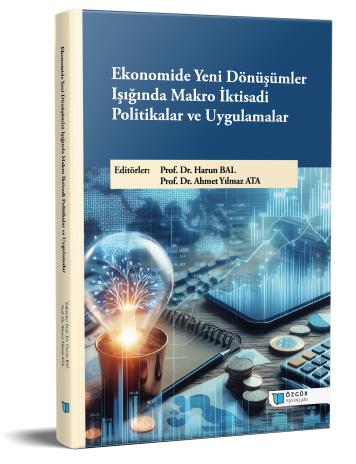
Macroeconomic Policies and Practices in Light of New Transformations in the Economy
Synopsis
As a scientific discipline, economics is прежде everything an analytical way of thinking, and this approach can be applied to all areas of individual and social life. Economics is primarily a social science that focuses on human beings. Therefore, any issue related to individuals and society falls within the scope of economic analysis and research. Within this framework, economics seeks to contribute by developing cause-and-effect analyses at both the micro and macro levels on many issues concerning individuals and society, and by proposing policies and recommendations. Like other social sciences, economics is a discipline with universal principles; however, it also possesses a methodology that revises these principles in response to changing times, places, and conditions, undergoes internal change and transformation, and develops new methods, analyses, and policies accordingly. Today, economic structures are undergoing rapid transformation due to factors such as technological advancements, globalization, and environmental imperatives. These transformations require the reassessment and updating of macroeconomic policies and practices.
This work, titled “Macroeconomic Policies and Practices in Light of New Transformations in the Economy,” has been prepared with the aim of understanding these transformations and examining how effective macroeconomic policies should be designed in this new era. The volume has been compiled from the studies of young scholars, academics, and researchers from different disciplines and diverse fields of study.
This work examines the fundamental principles and instruments of macroeconomic policies in light of contemporary economic theories and practices, and discusses the policies to be pursued in achieving macroeconomic objectives. Moreover, within the framework of the opportunities and threats created by economic transformations, it serves as a comprehensive guide for policymakers, academics, and students. The book primarily aims to establish an interaction between theoretical knowledge and its analytical reflections, thereby offering new approaches to current and pressing economic issues. The topics addressed in the volume are particularly noteworthy, as they both reflect perspectives from different disciplines and represent a synthesis of theory and practice. In this study, first and foremost, diverse and innovative perspectives on “economic growth,” the most fundamental macroeconomic issue for countries, are presented. In addition, the volume includes sections on policies to combat inflation and unemployment, energy and climate policies, foreign trade policies, as well as policies related to the financial and banking sectors.
We hope that this work will play an enlightening role in shaping future economic policies by providing readers with in-depth insights into understanding and interpreting economic transformations.
Chapters
How to cite this book
License

This work is licensed under a Creative Commons Attribution-NonCommercial 4.0 International License.
Published
ISBN
DOI
Statistics
Categories
Copyright (c) 2025 Harun Bal- Ahmet Yılmaz Ata; Doğan Barak- Halim Tatlı- Fatih Akın- Ayşe Eryer- Rüya Ataklı Yavuz- Refika Görkem Yılmaztürk- Selen Savaşkan- İlknur Aşkın- Harun Bal- Koray Yıldırım- Esma Erdoğan- Süleyman Gürbüz- Nur Aydın- Ayşe Arı- Mehmet Ozan Akman- Bahadır Aybakan- Devran Deniz- Mustafa Orhan Özer- Gökhan Özkul- Özgenur Çakır Uysal- Tahsin Avcı- Emre Kılıç- Eren Ergen