
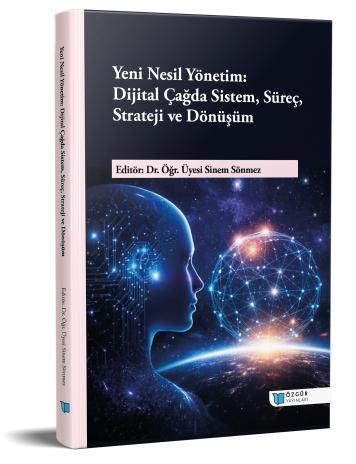
New Generation Management: Systems, Processes, Strategy and Transformation in the Digital Age
Synopsis
Upon deeper reflection, we realize that initial appearances often conceal underlying complexity.
As we continue to reflect through research, learning, and genuine understanding, we discover that complexity often gives way to clarity. What once appeared as a blurred image gradually sharpens in our minds. The structure, function, and network of relationships that give meaning to a whole become discernible; we begin to identify its boundaries, components, and the connections among them.
This intellectual threshold became particularly vivid to me while reading Biraz Daha Düşününce (Upon Further Reflection) by Bülent Eczacıbaşı. His approach to the layered nature of thinking has served as an inspiring point of departure for the preface of this book as well. As thinking deepens, curiosity grows and draws us further inward; yet this depth often produces awareness rather than certainty. When we come to realise that details and subtleties are endless, the wisdom embedded in Socrates’ words—“I know that I know nothing”—regains its full meaning. Much like Goethe’s Faust, after years of searching, we come to appreciate not the accumulation of knowledge itself, but the enduring value of continuous inquiry.
In this context, the intellectual legacy of Cahit Arf—one of the most distinguished scientists Türkiye has produced—stands as a quiet yet powerful source of inspiration in the background of this book. Arf regarded mathematics not merely as a discipline that yields results, but as one of the purest and most honest forms of thinking. He assessed the value of knowledge through the questions it enables us to ask. Today, as we discuss artificial intelligence, digitalisation, and algorithmic decision-making processes, we still confront the same fundamental questions: What do we know, what do we believe we know, and upon which assumptions are our thoughts constructed?
The purpose of thinking and learning, then, is not to reach absolute truths, but to expand consciousness, heighten sensitivity, and build work on a responsible, meaningful foundation. The main aim of this book aligns with this purpose. Academic production is an essential part of this journey.
As long as I can remember, my relationship with books has held a special place in my life. I have always preferred to begin with prefaces, introductions, and cover notes before engaging with the main text. These sections represent the author’s first point of contact with the reader, where the intention, direction, and intellectual background of the work are conveyed in their most distilled form. For this reason, I believe that the opening of this book—prepared in collaboration with Özgür Yayınevi and shaped by the contributions of distinguished academics and researchers—deserves particular care and attention.
The present volume addresses contemporary and multifaceted issues, including new generation management approaches, digitalisation processes, the transformative impact of artificial intelligence on organisations, and strategic decision-making mechanisms, drawing on perspectives from multiple disciplines. The chapters span a broad spectrum, ranging from the implications of artificial intelligence for management and capital structures to organisational transformation dynamics, from digital leadership to corporate mission, vision, and values, and from digitalisation practices in sectors such as disaster management and civil aviation to analytical decision-making models. In addition, themes such as occupational health and safety, educational management, and human-centred transformation open space for discussions on the ethical, social, and managerial dimensions of technological progress.
By bringing together theoretical frameworks and practice-oriented analyses, these chapters not only describe the current state of affairs but also provide a foundation for future intellectual and managerial debates. Each contribution, while engaging with the existing literature from its own distinct focus, invites the reader to think across disciplines and to reconsider established assumptions.
It is my hope that this book will encourage its readers not so much to seek definitive answers, but to ask better questions; that it will serve as a resource that deepens thinking, makes connections visible, and offers new perspectives for academic inquiry.
Chapters
How to cite this book
License

This work is licensed under a Creative Commons Attribution-NonCommercial 4.0 International License.
Published
ISBN
DOI
Statistics
Categories
Copyright (c) 2025 Sinem Sönmez; Ergül Söylemezoğlu- Neşe Kafa- Özden İbrahimağaoğlu- Miray Celepli Sütbaş- Gaye Atilla- Bülent Bayrak- Özge Öztürk- Çiğdem Pank Yıldırım- Duygu Akyüz- Şilan Özdamar- Ayhan Işık- Aytuğ Sözüer- Bünyamin Çelebi- Mehmet Aytekin- Lale Karasu- Emre Karasu- Mehmet Güven- Abdullah Fırat