
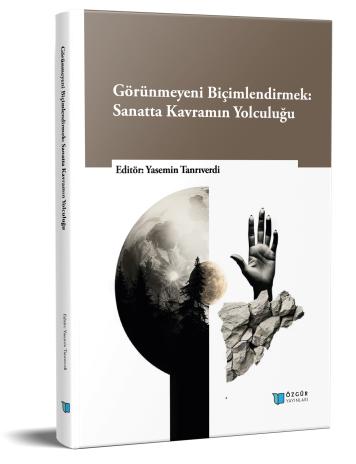
Shaping the Invisible: The Journey of Concept in Art
Synopsis
Shaping the Invisible: The Journey of the Concept in Art is an interdisciplinary edited volume that examines the decisive role of the concept in artistic production through historical, theoretical, and practical perspectives in contemporary art. The book brings together approaches that emphasize art not merely as a formal or aesthetic field, but as an intellectual, critical, and conceptual practice of production.
This volume explores how the concept has become a central component of artistic practice from modernism to contemporary art, and how the invisible—such as thought, memory, identity, the body, time, space, and social structures—is rendered visible through artistic processes. The chapters invite readers to reconsider the relationship between concept and form across diverse disciplines, including conceptual art, performance, installation, ceramics, new media, digital art, and public art.
The contributing authors position artistic production not as a result-oriented object, but as a practice grounded in research, process, experience, and critique, thereby revealing the transformative power of the concept in art. In this context, the book foregrounds modes of production in which the concept is no longer merely an explanatory tool, but becomes art itself.
Shaping the Invisible aims to offer researchers, artists, students, and curators interested in art theory, contemporary artistic practices, and interdisciplinary thought the opportunity to trace the journey of the concept in art through a polyphonic and critical perspective.
Chapters
How to cite this book
License

This work is licensed under a Creative Commons Attribution-NonCommercial 4.0 International License.
Published
ISBN
DOI
Statistics
Categories
Copyright (c) 2025 Yasemin Tanrıverdi; Seyit Mehmet Buçukoğlu- Sefa Ersan Kaya- Gültekin Akengin- Asuman Aypek Arslan- Tuba Batu- Ece Yücel- Şule Sayan- A. Sultan Karaoğlu- Arzu Parten Altuncu- Emine Jessica McKIE