
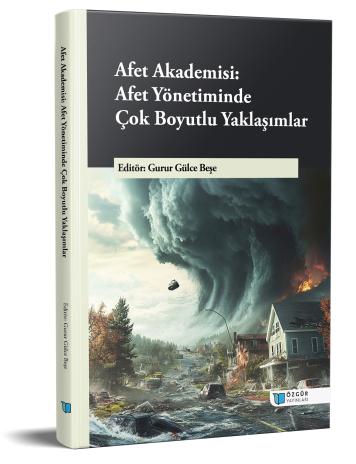
Disaster Academy: Multidimensional Approaches to Disaster Management
Synopsis
A disaster is a complex process that simultaneously concerns healthcare services, public policies, social vulnerabilities, ethical responsibilities, legal regulations, human rights, and interinstitutional coordination. Disaster management must therefore be evaluated not only in terms of response capacity at the time of a disaster, but also in conjunction with preparedness, risk reduction, appropriate triage, rapid intervention, the protection of vulnerable groups, and post-disaster recovery processes.
This book was prepared within the scope of the Disaster Academy through the contributions of academics, experts, and healthcare professionals from a variety of disciplines. By bringing together subjects such as the social dimensions of disasters, public policy, vulnerable groups, healthcare services, emergency response, trauma management, ethics, law, and human rights, the book seeks to offer a comprehensive perspective on disaster management.
As the editor, my principal objective throughout the preparation of the book was to bring together the knowledge and expertise originating from different areas of specialisation within a shared academic framework and to combine theoretical, practical, and practice-oriented contributions to disaster management. Each chapter approaches the challenges encountered in disaster preparedness and response processes from a different perspective, thereby providing readers with both conceptual insights and a field-oriented outlook. One of the central aims of this work is not only to understand the social effects of disasters, but also to reveal the foundations of knowledge, coordination, and responsibility upon which life-saving decisions in the field are made.
The process of preparing this book also holds a particular personal significance for me because of my connection to the city of Kahramanmaraş—my grandmother’s hometown, a place where we also lived for a period and which holds a special place in our family memory. Losing people from our immediate circle in the earthquakes of 6 February transformed my reflections on disaster management from a purely academic or editorial matter into something profoundly personal. It led me to feel more deeply that preparedness, coordination, accurate information, and timely intervention can sometimes determine the difference between life and death.
I would like to express my sincere gratitude to all the contributing authors, the project team whose efforts made the Disaster Academy possible, and all the stakeholders who support the production of knowledge in the field of disaster management.
With the hope that this book will contribute to efforts to build a disaster-conscious, responsive, and well-coordinated society, I dedicate it to the cherished memory of my grandmother, through whom Kahramanmaraş became part of my family’s collective memory; to the memory of those close to us whom we lost in the earthquakes of 6 February; and to all the lives lost in disasters of every kind.
Gurur Gülce Beşe
Office of the Ombudsperson for the Prevention of Discrimination and Equality, Istanbul Medipol University
Editor
Chapters
How to cite this book
License

This work is licensed under a Creative Commons Attribution-NonCommercial 4.0 International License.
Published
ISBN
DOI
Statistics
Categories
Copyright (c) 2026 Gurur Gülce Beşe; Fırat Semih Avşar- Mahmut Said Çam- Ümit Topcuoğlu- Gurur Gülce Beşe- Şerafettin Okan Yayla- Tuba Işık- Serinay Altundağ- Yiğit Aydın Şahin- Şeyma Tosun- Yasin Hasgül- Arzu Güneş- Çilem Bakar Aynacı