
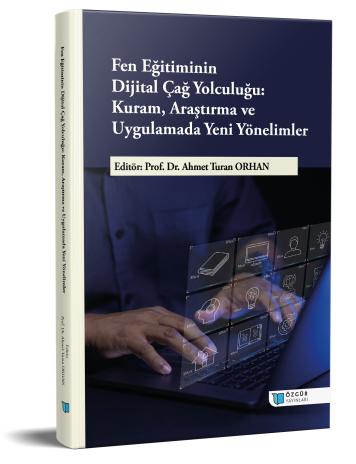
The Journey of Science Education in the Digital Age: New Directions in Theory, Research, and Practice
Synopsis
This book consists of seven chapters addressing different dimensions of science education. The chapters cover a wide range of topics, from contemporary teaching approaches to digital learning ecosystems, from game-based teaching to environmental education and ethnobiology integration, revealing the theoretical and pedagogical foundations of innovative and student-centered practices in science education.
The first chapter is structured under the heading “Analysis of Conceptual Structures in Science Education: A Natural Language Processing-Based Framework.” This chapter addresses the use of Natural Language Processing (NLP) technologies as a pedagogical tool to make students' thinking processes and conceptual understanding visible in science education. It highlights that traditional assessment methods are insufficient for identifying conceptual misconceptions and cognitive patterns hidden in students' written responses, while NLP has the potential to analyze these processes in a scalable, fast, and meaningful way.
The second section, titled “Ethnobiology in Science Education,” is presented in English. This section addresses the theoretical foundations and pedagogical implications of integrating ethnobiology into science education. Based on a review of the literature, the study concluded that science teaching is often abstract and disconnected from cultural contexts; it demonstrated that ethnobiology makes learning more meaningful and lasting by connecting students' local knowledge and experiences with scientific concepts. Furthermore, it highlights that this approach develops scientific literacy and critical thinking skills; however, factors such as teacher competencies, lack of materials, and curriculum rigidity limit its widespread application.
The third chapter is titled “Digital Science Learning Ecosystems in the Context of Sustainability Education.” This chapter examines the theoretical and practical aspects of Digital Science Learning Ecosystems (DSLEs) in the context of sustainability education, emphasizing the paradigm shift that digital transformation has created in science education. DFLEs are considered as a digital extension of Bronfenbrenner's ecological systems theory and are grounded in the approaches of Connectivism, Constructivism, and Systems Thinking.
The fourth section is titled “Escape Games.” This section highlights the value that educational games add to the learning process and emphasizes the pedagogical potential of escape room games in particular. Educational games make learning more effective by increasing student participation, motivation, and creativity, providing an interactive environment that allows for mistakes and provides instant feedback. Escape room games provide participants with an interactive learning experience based on clue solving, teamwork, and problem-solving processes.
The fifth chapter is titled “The Effect of Inquiry-Based Learning Supported by Digital Stories on Middle School Students' Academic Achievement, Creativity, and Scientific Inquiry Skills.” This section examines the effects of inquiry-based learning supported by digital stories on students in the DNA and Genetic Code unit. In the semi-experimental design study, two groups, one experimental and one control, were compared at the 8th grade level. While inquiry-based activities supported by digital stories were implemented in the experimental group, traditional teaching was continued in the control group. Analysis of the data collected through academic achievement, scientific creativity, and inquiry skills tests revealed significant differences in favor of the experimental group.
The sixth chapter is titled “An Example of Applying Mind and Intelligence Games with Science Cups in Science Lessons.” This chapter examines the effects of the educational game called “Science Cups” on science lessons, based on student opinions. Inspired by the Practical Cups game, this material aims to support students' ability to establish relationships between concepts, classify, and improve their attention skills through its structure based on color and concept matching. In the case study design research, students found the game both educational and fun; it was noted that the game facilitated concept learning and increased interest and motivation.
The seventh chapter is titled “Evaluation of Environmental Issues in the Science Education Curriculum from the Teachers' Perspective.” This chapter examines the views of science teachers working in industrialized areas of Kocaeli on environmental issues and environmental education in the curriculum. In this study, conducted using a qualitative research and survey model, a descriptive analysis of semi-structured interviews with 14 teachers was performed. The findings show that teachers most frequently encounter air and water pollution problems in the region. Most teachers emphasized problems such as insufficient class time, the exam-focused system pushing environmental education into the background, and some environmental concepts not being appropriate for the students' level.
I would like to express my sincere gratitude to the chapter authors who contributed to the creation of this book, titled “The Journey of Science Education in the Digital Age: New Directions in Theory, Research, and Practice,” for their valuable contributions.
Editor
Prof. Dr. Ahmet Turan ORHAN
Chapters
How to cite this book
License

This work is licensed under a Creative Commons Attribution-NonCommercial 4.0 International License.
Published
ISBN
DOI
Statistics
Categories
Copyright (c) 2025 Ahmet Turan Orhan; Erhan Ceylan- Özgür Özünlü- Oktay Göktaş- Selda Bakır- Ekrem Dağ- Kevser Şentürk- Ayberk Bostan Sarıoğlan- Esra Sayar- Erdem Gencal- Hasan Genç- Huriye Deniş Çeliker