
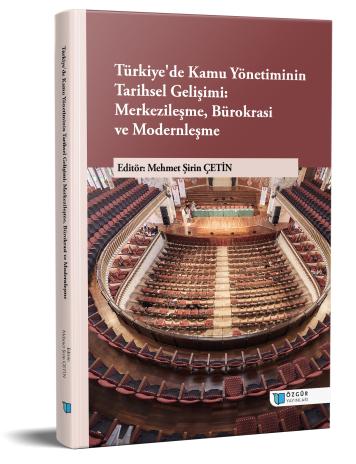
The Historical Development of Public Administration in Turkey: Centralisation, Bureaucracy and Modernisation
Synopsis
Public administration is a dynamic process through which the state carries out planning, organising, directing and supervising activities with the aim of meeting societal needs. The fundamental objective of this process is to respond accurately and effectively to public needs. On this basis, it is also possible to outline the characteristics of public administration. Public administration is a structure that serves the public interest, is linked to the state, is service-oriented and is based on various rules. Taking these characteristics into account: the prioritisation of the public interest implies that social benefit takes precedence over individual benefit; its connection to the state implies that the process is carried out by public institutions; and its service-oriented nature implies the fulfilment of fundamental social needs such as education, health, and transport. The fact that public administration is based on rules implies that tasks and procedures are carried out in accordance with legislation.
This study examines the historical development of public administration in Turkey from the founding of the Republic to the present day. The study also covers the final period of the Ottoman Empire. The main reason for this is that certain institutional structures and practices of public administration in the early Republican period were inherited from the Ottoman era. Within this framework, it was deemed necessary to examine this period as well in order to analyse the historical transformation of public administration in a comprehensive manner.
In structuring the chapters, the political, economic and social developments that directly or indirectly influenced public administration in Turkey were taken as the basis; the study has been designed in eight chapters. Within this scope, the study comprises the following chapters:
1. Public Administration in the Ottoman Empire: Centralisation, Reforms and Bureaucratic Modernisation
2. The Construction of Public Administration in the Early Republican Period: Centralisation and the Establishment of the Modern State (1923–1946)
3. Public Administration in the Era of Multi-Party Politics and Planned Development: Bureaucracy and the Transformation of the State (1946–1980)
4. Public Administration in the Era of Neoliberal Transformation: Restructuring and Centre-Periphery Relations (1980–1990)
5. Public Administration in the Era of Coalitions: Bureaucratic Crises and Governance Issues (1990–2000)
6. Reforms and the EU Process: Modernisation and Institutional Transformation in Public Administration (2000–2016)
7. The Presidential System of Government: Centralisation and a New Governance Paradigm (2016–2026)
8. The Future of the Merit Principle in Public Administration: From Bureaucratic Modernisation to AI-Supported Human Resource Management
Through these chapters, the historical development, institutional transformation and future directions of public administration in Turkey are examined from a comprehensive perspective. This work has been prepared with the contributions of distinguished academics specialising in the field of public administration. The chapters have been addressed in detail and with great care by the authors, and have also been reviewed by the editor. I would like to thank all the authors, the editorial team and Özgür Yayınları, who made the publication of this work possible, for their contributions during the preparation and publication process.
I hope that this study, which examines the historical development of public administration in Turkey from the perspectives of centralisation, bureaucracy and modernisation, will prove useful to our readers and contribute to the field.
Yours sincerely.
Chapters
How to cite this book
License

This work is licensed under a Creative Commons Attribution-NonCommercial 4.0 International License.
Published
ISBN
DOI
Statistics
Categories
Copyright (c) 2026 Mehmet Şirin Çetin; Yusuf Muyan- Mustafa Fahri Mirhanoğulları- Mehmet Şirin Çetin- Serdar Şenol- Abdurrahman Turgut- Zekerya Çavuş- Selami Özkan- Mustafa Gökberk Ertan