
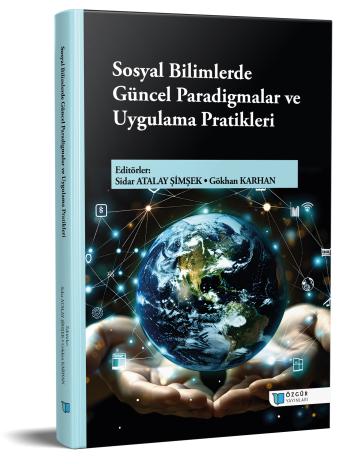
Current Paradigms and Practical Applications in Social Sciences
Synopsis
The rapidly changing social, economic, and environmental conditions of the 21st century have increased the need for new research perspectives and multidimensional practical approaches in the social sciences. This book addresses current paradigm shifts across various fields of social sciences and their practical implications from an interdisciplinary perspective. The chapters in the book go beyond theoretical analysis, also showcasing the real-world impact of social sciences through field studies and applied examples.
The first chapter, titled “Cultural Heritage and Environmental Sustainability: The Impact of Climate Change on Cultural Heritage,” highlights the multifaceted threats that climate change poses not only to the natural environment but also to humanity’s shared cultural heritage. As emphasized by UNESCO, these threats present significant risks in terms of cultural continuity, social identity, and resilience; thus, the relationship between cultural heritage and environmental sustainability must be reconsidered within this context.
One of the significant contributions of this book lies in its inclusion of studies that explore the role of social justice in the fight against climate change. In this context, the second chapter titled "Intersections of Just Transition, Resilience, and Climate Justice" emphasizes that environmental transformation policies cannot be limited to purely technical or economic dimensions but must also be addressed through the principles of social equity, justice, and resilience. The chapter presents an integrated “just resilience” framework by combining the fair distribution of social costs (just transition), institutional adaptive capacity (resilience), and the ethical foundations of climate justice. This approach not only highlights the social dimensions of climate policies but also enables the development of more inclusive and sustainable strategies.
Another significant contribution is presented in the chapter titled “The EU’s New Pact on Migration and Turkey’s Position: Opportunities, Risks, and Adaptation Needs.” Within the framework of the European Union’s new migration policies, the chapter offers a comprehensive analysis of the opportunities and threats facing Turkey. It emphasizes the need for sustainable and rights-based migration management policies in response to these emerging dynamics.
The chapter titled “The International Normative Framework of Urban Rights: Documents, Principles, and Implementation Limitations” in this book examines how human rights are addressed in the urban context through key international documents and sheds light on the historical, institutional, and normative development of urban rights. The chapter emphasizes that cities are not only spaces where rights are violated, but also places where rights are realized and institutionalized through local governance. Urban rights are presented as a holistic framework encompassing areas such as housing, environment, participation, equality, culture, digital rights, and sustainability.
Through the analysis of significant documents such as the European Charter of Local Self-Government, the European Urban Charters, the World Charter for the Right to the City, the UCLG Global Charter-Agenda, and UN-Habitat declarations, the chapter reveals both the expanding content of urban rights and the persistent limitations in their implementation. It argues that while this normative framework offers a strong reference point for rights-based and participatory urban governance, effective local implementation requires enhanced governance capacity, institutional structure, and resource justice.
The chapter titled “Governance Quality and the Institutional Limits of Sustainable Markets: Evidence from Türkiye” in this book evaluates the impact of governance quality on Türkiye’s sustainable economic growth through a data-driven analysis. Using the World Bank’s Governance Indicators, the asymmetric effects of good governance on real GDP per capita are examined through the NARDL model. The findings reveal that both positive and negative governance shocks have a contractionary effect on economic performance.
These results suggest that changes in governance quality can create direct and short-term adjustment costs in market outcomes, offering a more critical and multidimensional perspective on the relationship between governance and economic growth.
The chapter titled “The Impact of Credit Card Usage on Consumption Expenditures in Türkiye”, which focuses on financial behaviors and consumption habits, goes beyond traditional economic approaches to evaluate consumption dynamics in the light of behavioral economics theories, analyzing the psychological and sociological effects of credit cards.
In the context of economics and finance, the chapter titled “Foreign Exchange Reserves and the Stock Market: The Role of Central Bank Policies on Market Dynamics” examines the impact of central bank policies on foreign exchange reserves and the stock market using the case of Türkiye, highlighting the structural role central banks play in maintaining financial market stability.
The chapter titled “The Impact of Job Satisfaction and Psychological Empowerment Practices on the Quality of Life of Private Security Personnel”, which contributes to the field of work life and organizational behavior, examines in detail the relationships between job satisfaction, psychological empowerment, and quality of life among private security personnel in the case of Batman, Türkiye. It particularly highlights the influence of regional conditions on employee well-being.
In conclusion, this book offers a rich content in terms of both theoretical depth and practical applicability by addressing current trends in the social sciences from an interdisciplinary perspective. Each chapter not only analyzes today’s complex social, environmental, economic, and governance-related issues but also demonstrates the transformative power of the social sciences by offering solutions. In this context, the volume serves as a significant reference not only for the academic community but also for policymakers, practitioners, and civil society actors. Emphasizing the necessity of innovative approaches and holistic analyses in social sciences, this work aims to inspire all stakeholders who seek to develop fairer, more sustainable, and human-centered solutions to contemporary challenges.
Editors
Sidar ATALAY ŞİMŞEK
Gökhan KARHAN
Chapters
How to cite this book
License

This work is licensed under a Creative Commons Attribution-NonCommercial 4.0 International License.
Published
ISBN
DOI
Statistics
Categories
Copyright (c) 2025 Sidar Atalay Şimşek- Gökhan Karhan; Makbule Şiriner Önver- Günay Gönüllü- Ayşegül Kanbak- Merve Öztürk- Nihal Şirin Pınarcıoğlu Ocakhan- Hamdullah Dönmez- Zeynep Karhan- Hamza Şimşek- Seda Özcan- Esat Atalay- Nalan Altun